
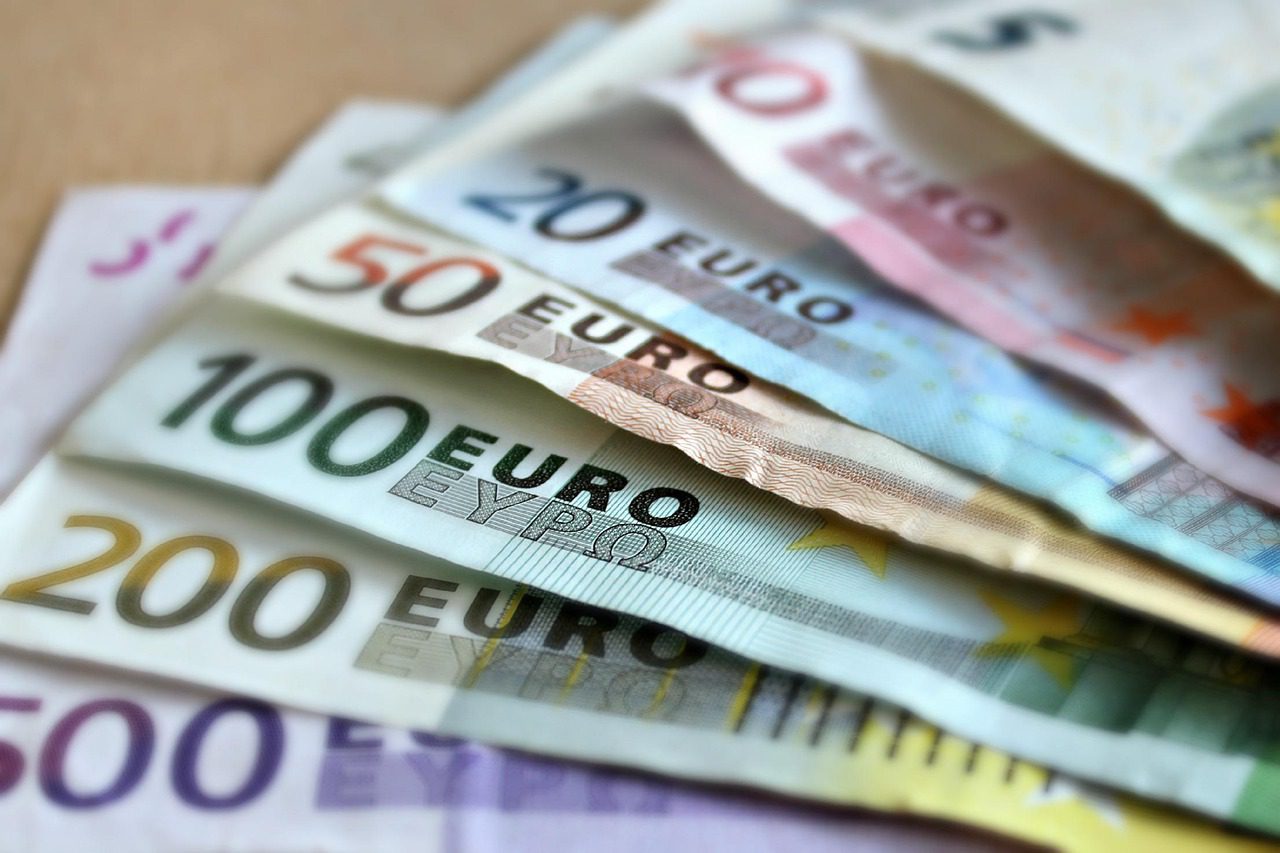
You’re planning a trip to France, Spain, or another region in the Eurozone, and somewhere on your list you need to buy euros. Most Canadians assume the place they buy them barely matters. A few dollars here or there, who cares. That assumption is exactly what costs them money.
Here is what actually happens. When you convert Canadian dollars (CAD) to euros (EUR), the provider quietly builds a margin into the exchange rate. You never see it as a fee since it’s baked into what you’re quoted. For a few hundred euros, that margin is small. But on a $5,000 or $10,000 euro purchase for a long European stay, it adds up to hundreds of dollars.
This guide breaks down the top ways to buy euros in Canada, what each one is actually good for, and how to protect the exchange rate on larger amounts so you keep more of your money.
Where can you buy euros in Canada?
You have four main routes to buy euros, and each fits a different need. But all include a couple components:
- The mid-market rate is the true, real-time value of one currency against another and is the rate banks use when trading with each other. You can look it up on the Bank of Canada or a tool like XE.
- The spread is the gap between that real rate and the rate a provider gives you. That gap is the provider’s margin, and it’s where almost all the extra cost of buying euros sits. A provider can advertise “no fees” and still charge you 3% through a wide spread.
With that in mind, here are the most common options.
At your bank
Your bank is the most familiar route, and for small amounts, it’s convenient. You can often order euro cash through online banking or at a branch, then pick it up in a few business days.
Don't Waste Money With Banks.
Get Exchange Rates Up to 2% Better With KnightsbridgeFX
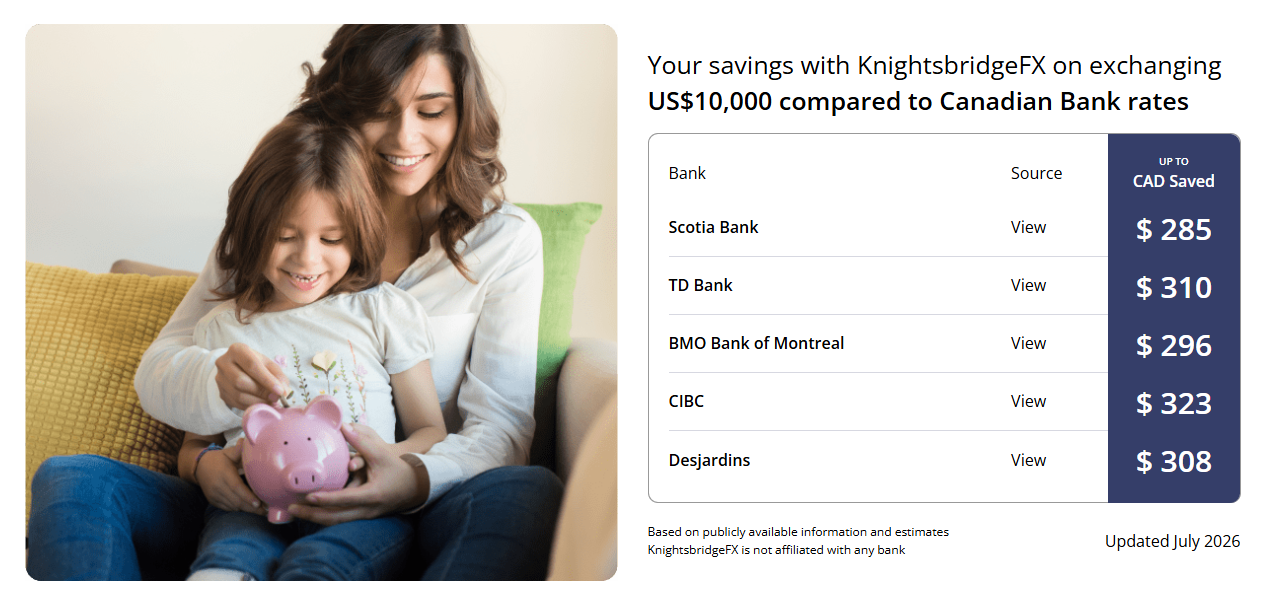
The trade-off is the rate. Canada’s major banks typically build a spread of 2% to 3% above the mid-market rate into foreign currency, and cash rates tend to be wider still because physical currency costs more to ship and handle. Banks also frequently keep only common currencies like euros, U.S. dollars, and pounds sterling on hand, with other currencies needing several days’ notice.
At a currency exchange service
Standalone currency exchange shops, the kind you see in malls and downtown cores, deal in physical cash and can be quick for in-person pickup. Some advertise competitive rates to draw you in.
But read the rate carefully before you commit. Storefront exchanges vary widely, and the convenient ones often carry a spread similar to or worse than a bank. The “0% commission” sign on the window refers to a flat fee, not the spread, so it tells you very little about the real cost.
Through an online FX or transfer provider
Online foreign exchange and money transfer providers send money electronically between accounts rather than handing you cash. This is where the currency exchange rates get sharp because electronic transfers cost far less to process than physical currency.
A specialist like KnightsbridgeFX prices closer to the mid-market rate and passes the savings to you, which matters most when you’re converting a meaningful sum. The trade-off is that you receive euros in an account, not as cash in hand, so this route suits funding a European account, paying for a property, or topping up a travel card rather than grabbing spending money the day before you fly.
At the airport
Airport kiosks are the most convenient and the most expensive place to buy euros, full stop. They know you’re out of options and price accordingly, often with spreads of 5% or more above the real rate plus a service fee on top.
Use an airport kiosk only for a small emergency amount. Never plan your euro purchase around one.
How to get the best euro exchange rate
Now let’s talk about where you can save real money. The rate, not the fee, is what determines your cost, and a small percentage difference is larger than it looks.
Say you are buying €10,000 for an extended stay. At the early-October 2025 reference rate, one euro cost about $1.63 CAD, so that purchase runs roughly $16,300 CAD before any margin. A provider charging a 3% spread takes about $489 on top, yet a provider charging closer to 0.5% takes about $82. Same euros, same day, with a difference of around $400 decided entirely by where you bought them.
To protect your rate, a few habits help:
- Look up the mid-market rate first. Check the Bank of Canada or XE before you buy, then compare every quote against it. The gap is your real cost.
- Separate the fee from the spread. A waived transfer fee means nothing if the rate is padded. Always compare the all-in rate you actually receive.
- Match the method to the amount. Get cash for small spending money, and use an electronic specialist for larger sums where the spread does real damage.
For larger euro purchases, this is where KnightsbridgeFX fits. As a Canadian foreign exchange specialist, it offers bank-beating CAD to EUR rates with no hidden fees, so more of your money converts. You can preview the math anytime with our online currency converter before committing to anything.
Buying euro cash vs. spending digitally in Europe
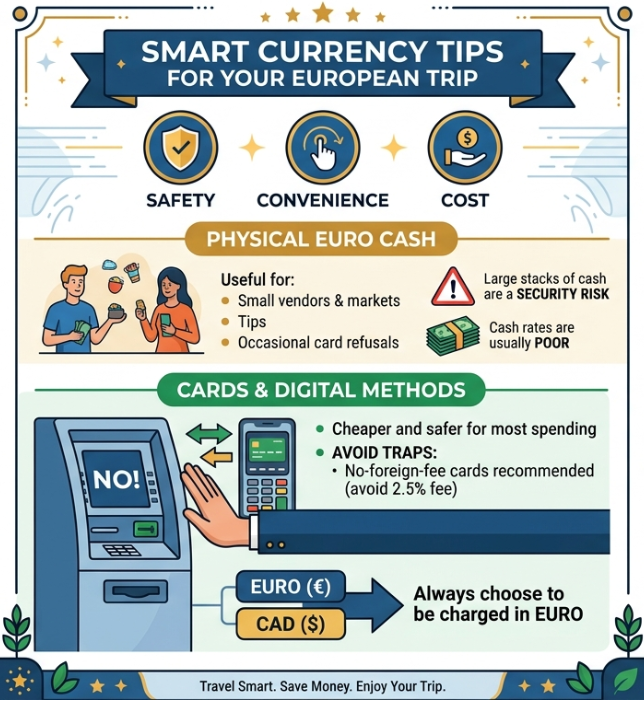
You don’t need to convert your whole trip budget into physical euros before you leave. Deciding how much cash to carry comes down to three things: safety, convenience, and cost.
Physical euro cash is useful for:
- Small vendors
- Markets
- Tips
- The occasional place that still waves off cards
But carrying a large stack of cash is a security risk, and you bought those euros at a cash rate, which is usually the worst rate available.
For most spending in the European Union, cards and digital methods are cheaper and safer, provided you avoid the traps. Many Canadian credit cards charge a foreign transaction fee of around 2.5% on every purchase abroad, so a no-foreign-fee card is worth having.
Decline “dynamic currency conversion” at terminals and ATMs, the prompt that offers to charge you in Canadian dollars, because the built-in rate is consistently poor. Always choose to be charged in euros.
A practical split for most travellers: carry a few hundred euros in cash for arrival and small purchases, then rely on a no-foreign-fee card for the rest. If you are funding a longer stay or a larger expense, move the bulk through a low-spread provider rather than buying it all as cash.
Which option is right for you?
The right choice comes down to how much you are buying and what you need it for.
- Small spending cash (a few hundred euros): This is best for convenience. Your bank or a fair currency exchange service is fine since the spread on a small amount is not worth chasing.
- A no-foreign-fee card for daily spending: This is the cheapest way to handle most purchases once you’re in Europe. Pair it with a little starter cash.
- A larger sum ($5,000 and up): This is where the spread can add up to hundreds of dollars. An online FX specialist with tight CAD to EUR rates is almost always the cheapest route.
- Last-minute euros at the airport: Use this only as a small emergency buffer, never as the plan.
If you are exchanging a larger euro amount, the next section is for you.
Save money on the euro exchange rate
When the amount is large, the rate matters, and that’s where a specialist beats a bank or a kiosk.
KnightsbridgeFX is a Canadian-based foreign exchange company, registered and regulated by FINTRAC, and has helped over 150,000 customers convert currency at competitive exchange rates the banks and airport kiosks can’t match. We work specifically with Canadians and Canadian banks, and there’s no physical cash markup and no hidden fee built into the rate—just a tight spread on your CAD to EUR conversion. And if you want to test first, you can start with a small exchange to see how it works before moving a larger amount.
Join over 150,000 Canadians who convert CAD to EUR with a free KnightsbridgeFX account, at rates the banks and airport kiosks can’t match.
Frequently asked questions about buying euros in Canada
Where is the cheapest place to buy euros in Canada?
For larger amounts, an online foreign exchange specialist is almost always cheapest because it prices close to the mid-market rate instead of padding it like banks and kiosks do. For small spending cash, your bank is reasonable, and the most expensive place is an airport kiosk, where spreads often top 5%. Whatever you choose, compare the quoted rate against the real mid-market rate to see the true cost.
Should I buy euros in Canada or wait until I arrive in Europe?
It depends on the amount and method. For a small buffer of spending cash, buying a little in Canada before you fly saves you from a bad airport rate on arrival. For larger sums, move travel money electronically through a low-spread provider to beat both Canadian cash rates and European ATM withdrawals. Avoid buying euros at the airport in either country, and always decline dynamic currency conversion abroad.
Can I order euros online for home delivery in Canada?
Some banks and currency services let you order euro cash online for branch pickup or home delivery, though availability and delivery fees vary by provider and region. For physical cash, this can be convenient. For larger amounts, an online FX provider that delivers euros electronically to an account is usually cheaper than ordering cash, since you avoid the wider markup that comes with physical local currency.

 AUD
AUD CAD
CAD EUR
EUR GBP
GBP NZD
NZD USD
USD
