

You checked your account and the deposit is smaller than expected. The sender confirmed the amount, the transfer went through, and yet hundreds of dollars are missing. This happens more often than most Canadians realize, and the reason is rarely just one fee. Multiple charges can quietly reduce the amount that lands in your account, often without any clear line item showing where the money went.
If you’re regularly receiving money from family abroad, payments from international clients, or transfers from your own accounts in another country, those small differences add up fast.
This guide breaks down exactly which fees apply when receiving money in Canada, how they compare across international money transfer costs, and what you (or the person sending) can do to keep more of every transfer.
What fees apply when receiving money in Canada?
Several different fees can reduce the amount you actually receive, and they don’t all come from one place. Some are charged by the sender’s institution before the money leaves. Others are deducted while the transfer moves through the banking network. A final fee is often taken by your Canadian bank or platform when the money arrives.
These costs are often invisible to the person receiving the money, not just the sender. Understanding where each one applies is the first step to avoiding them.
Third-party platform fees
Digital platforms like PayPal, Wise, and MoneyGram move small amounts of money quickly, but convenience has a price. PayPal, for example, applies a currency conversion fee of around 3% to 4% above the mid-market rate when funds arrive in a currency different from your account’s base currency, on top of any transaction fee charged to the sender. Wise is more transparent but still charges a small percentage on every conversion.
Don't Waste Money With Banks.
Get Exchange Rates Up to 2% Better With KnightsbridgeFX
These platforms trade cost for convenience. The flat service fee is usually visible, but the exchange rate markup is the larger hidden cost, and it scales with the size of the transfer. On a small payment, that markup might cost you a few dollars. On a $10,000 transfer, the same percentage costs hundreds.
Bank wire transfer fees
Most international transfers into Canada arrive as a wire through the Society for Worldwide Interbank Financial Telecommunication (SWIFT) network. Major Canadian banks, including RBC, TD, Scotiabank, BMO, and CIBC, typically charge $15 to $25 CAD to receive an international wire transfer. That fee is deducted from the amount arriving in your account.
The bigger problem is what happens before the money reaches your bank. The SWIFT network often routes funds through one or more intermediary banks, and each one may deduct a bank fee, sometimes $10 to $50 USD, before passing the transfer along. By the time the wire lands in Canada, the original amount sent and the amount received can differ by more than $100 on a single transfer, even before currency conversion.
This is one of the most common reasons recipients see less than expected. The sender paid $5,000 USD, but the recipient sees $4,850 USD or less in their account, with no clear explanation of where the difference went.
Cash pickup fees
Cash pickup services like Western Union and MoneyGram allow recipients to collect physical cash at a branch location. This method consistently carries the highest total cost, combining service fees with the widest exchange rate spreads on the market. Cash pickup is worth considering only if you don’t have bank account access, since both the service fee and the conversion markup eat into the transfer.
How fees compare by transfer method
The transfer method makes a real difference in how much money actually arrives. Each option has its own combination of fees, exchange rate risk, and speed. Comparing them side by side is the easiest way to see where your money is going.
| Transfer method | Typical receiving fee | FX markup risk | Intermediary fee risk | Estimated speed |
| Bank wire transfer (SWIFT) | $15 to $25 CAD | High | High | 1–5 business days |
| EFT or direct deposit | $0 to $5 CAD | Medium | Low | 1–3 business days |
| Interac e-Transfer | Free | None | None | Minutes to hours |
| PayPal | None visible | High (3% to 4%) | Low | Minutes |
| Cash pickup (Western Union, MoneyGram) | Bundled into rate | Very high | Low | Minutes |
The cheapest method depends on the size of the transfer, where the sender is located, and how quickly the money needs to arrive. The headline fee is rarely the full picture. Understanding the total cost, including exchange rate markups and intermediary deductions, is what separates a good decision from an expensive one.
For larger or recurring transfers, KnightsbridgeFX offers an alternative worth considering. As a Canadian-based foreign exchange specialist, KnightsbridgeFX provides bank-to-bank transfers with no wire fees and exchange rates that consistently beat the major banks.

Bank wire transfer (SWIFT)
Bank wire transfers are the most common method for sending large amounts internationally, but they’re also the most expensive in total. Between the $15 to $25 CAD receiving fee, the foreign exchange markup of 2% to 3% applied at conversion, and potential intermediary deductions, a single transfer can lose 3% to 4% of its value before it ever reaches the recipient’s account.
Electronic funds transfer (EFT) and direct deposit
An electronic funds transfer (EFT) moves money directly between bank accounts without going through the SWIFT network. Fees are typically lower, often $0 to $5 CAD on the receiving side, and there are no intermediary banks taking a cut. The trade-off is that EFT is generally limited to specific regions and currencies, and processing takes one to three business days.
Interac e-Transfer
Interac e-Transfer is Canada’s domestic transfer system and is typically free with most major Canadian bank accounts. The catch is that it only works for Canada-to-Canada transfers. If you’re receiving money from someone abroad, this isn’t an option directly, though the sender may convert and send through their own Canadian account if they have one.
PayPal
PayPal makes receiving small payments fast and convenient, especially from international clients or family. The fee structure is layered: the sender pays a transaction fee, and the recipient pays through the exchange rate markup if the payment arrives in a different currency.
For frequent freelancers or small business owners, those costs can add up quickly across many small transfers.
Cash pickup services
Cash pickup is the most expensive way to receive money, but it remains valuable for recipients who don’t have a Canadian bank account. The combined service fee and exchange rate markup typically total 5% to 10% of the transfer amount. For anyone with bank access, almost any other method will be cheaper.
Common questions about receiving money in Canada
Do I have to pay tax on money received from abroad in Canada?
Receiving money from abroad is not automatically taxable in Canada. Gifts and inheritances from family overseas are generally not subject to Canadian income tax, but income earned abroad, like payments for freelance work or business services, is taxable and must be reported on your tax return.
Transfers of $10,000 CAD or more must be reported to the Financial Transactions and Reports Analysis Centre of Canada (FINTRAC), but reporting is not the same as taxation. The report is a regulatory requirement for financial institutions, not a tax assessment against you. For specific tax questions, consult a Canadian tax professional.
Why did I receive less money than the sender sent?
Several deductions can reduce the amount you receive. Intermediary banks on the SWIFT network often take small fees before the transfer reaches Canada. Your receiving bank may charge a $15 to $25 CAD wire fee. If the transfer involved currency conversion, a currency exchange rate markup of 2% to 3% was likely applied by either the sender’s bank, your bank, or both. These deductions are usually not itemized, which is why the gap between sent and received can feel mysterious.
How long does it take to receive an international wire transfer in Canada?
International wire transfers typically take one to five business days to arrive, depending on the originating country, the number of intermediary banks involved, and any compliance reviews along the way. Transfers from the United States usually arrive within one to two business days. Transfers from regions with more complex banking relationships, or those flagged for review under anti-money-laundering checks, can take up to a week.
Pay less in fees when receiving money in Canada
The fees attached to receiving money in Canada are rarely a single bank charge. They’re layered: a wire fee here, an intermediary deduction there, an exchange rate markup on top. By the time a transfer lands in your account, the difference between what was sent and what you actually keep can be significant. The transfer method matters, and so does the provider handling the conversion.
KnightsbridgeFX is a Canadian-based foreign exchange specialist and money transfer service that helps individuals and families keep more of the money sent to them.
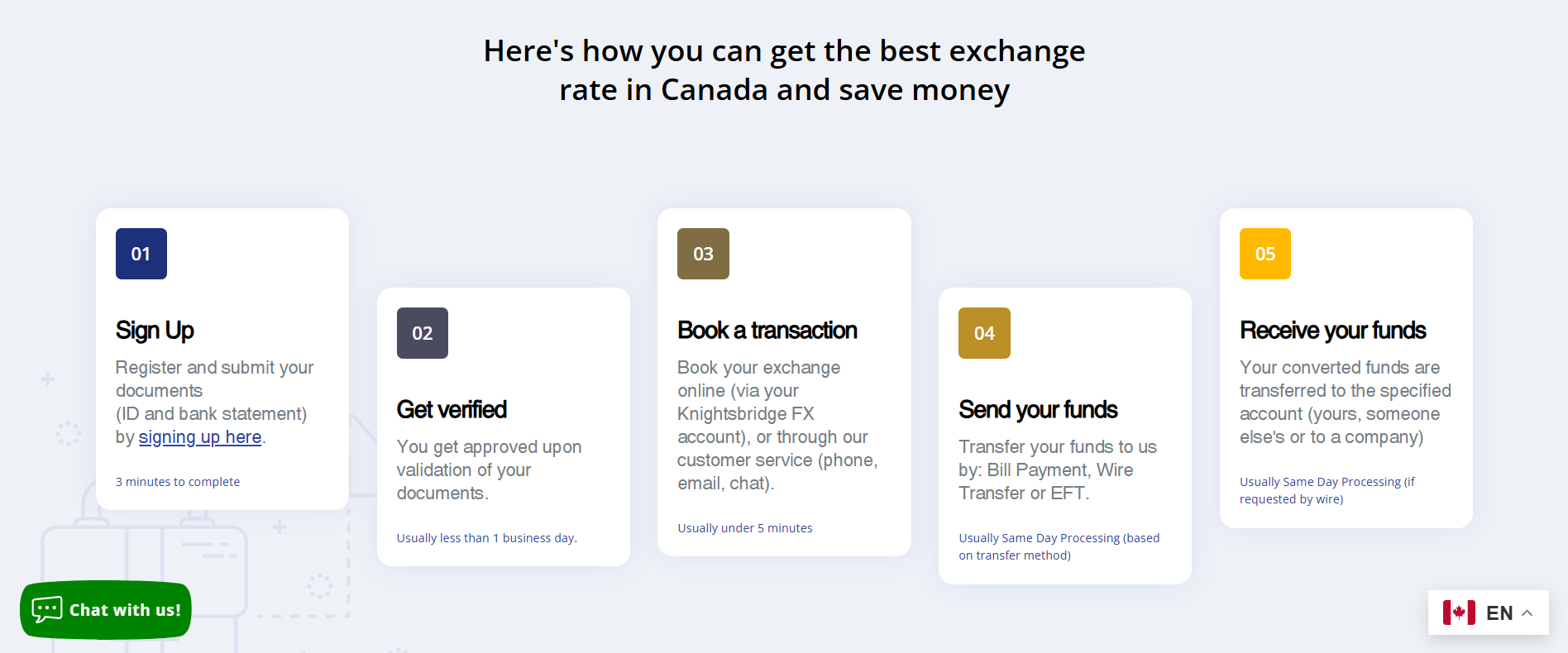
With no wire transfer fees, secure online wire transfers at exchange rates that consistently beat the major Canadian banks, and a Best Rate Guarantee backed by billions in transfers processed since 2009, KnightsbridgeFX makes the cost of every transfer clear from the start. Funds are held securely in a segregated account at a major Canadian financial institution, and real human support is available every step of the way, whether you’re coordinating a one-time transfer or managing recurring payments.
Open your free KnightsbridgeFX account today to bypass the hidden fees of traditional wire transfers and ensure the full value reaches your Canadian account.

 AUD
AUD CAD
CAD EUR
EUR GBP
GBP NZD
NZD USD
USD
