
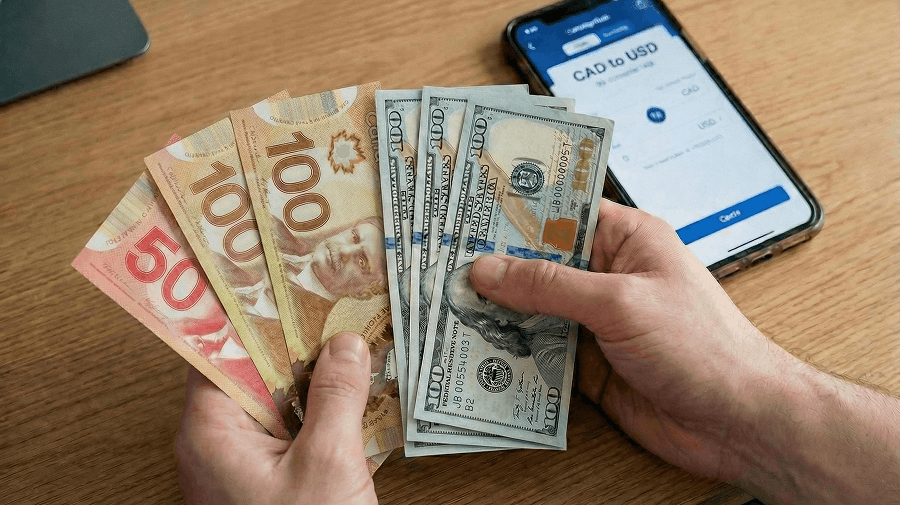
Every year, Canadians lose hundreds of millions of dollars to bank exchange rate markups they never see coming. If you’ve ever sent money abroad, exchanged for foreign cash, or supported family overseas, you’ve likely paid more than you realized. The difference between what banks charge and what you could pay elsewhere is significant.
Canada’s Big Five banks—RBC, TD, Scotiabank, BMO, and CIBC—all offer foreign currency exchange and international transfer services. But their rates typically include markups up to 5% above the mid-market rate, plus transfer fees ranging from $1.99 to $125, depending on the institution and transaction size. A $10,000 transfer could add $200 to $500 in unexpected costs.
To help you keep more of your hard-earned money, we break down what each major bank offers and where you can do better.
Which Canadian banks offer the best exchange rates?
Again, all five major Canadian banks allow you to send money internationally, whether you’re sending to France, Barbados, New Zealand, or Switzerland. However, their pricing follows a similar pattern. While fees and features differ, the biggest cost comes from exchange rate markup.
Royal Bank of Canada (RBC) exchange rates and fees
- Markup: 2.5% to 3.5% above mid-market
- Transfer fees: $0
- Standout feature: Covers 200+ countries
Best for: Global coverage and established infrastructure
Watch out for: High combined cost from fees and rate markup
TD Bank currency exchange offerings
- Markup: 3% to 4% above mid-market
- Transfer fees: $0 to $50
- Standout feature: Same-day transfers available
Best for: Urgent transfers
Watch out for: Wide markup range on exchange rates
Don't Waste Money With Banks.
Get Exchange Rates Up to 2% Better With KnightsbridgeFX
Scotiabank foreign exchange rates
- Markup: 2.5% above mid-market
- Transfer fees: $0 or $1.99 for select countries
- Standout feature: Access to thousands of ATMs globally
Best for: Low-cost transfers to eligible countries
Watch out for: Limited availability of the $1.99 fee and standard markup still applies
Bank of Montreal (BMO) international transfer costs
- Markup: 2.5% to 3.3% above mid-market
- Transfer fees: $7 to $50
- Standout feature: Management of multiple currencies in one account
Best for: Basic online access and mobile transfers
Watch out for: Highest fee range among major banks
Canadian Imperial Bank of Commerce (CIBC) cross-border payment options
- Markup: 2.5% to 3.5% above mid-market
- Transfer fees: $0 on select services
- Standout feature: Cross-border banking for frequent U.S. travelers
Best for: Fee-free transfers on select options
Watch out for: Exchange rate markup still drives the total cost
How do Canadian bank exchange rates compare to alternatives?
The gap between what banks charge and what specialized providers offer is wider than most Canadians realize. Here’s how they compare.
Credit unions vs. major banks
Credit unions position themselves as community-focused alternatives, but their foreign exchange offerings rarely deliver meaningfully better rates. Most apply similar 1%–5% markups above mid-market, and many have more limited digital platforms and fewer currency pairs than the Big Five.
Processing times can take 3 to 5 business days, compared to 1 to 3 days at major banks. For small, occasional transfers with an existing credit union relationship, they’re a reasonable option, but they often don’t outperform specialized currency providers.
Online money transfer services vs. traditional banking
Currency exchange services like Wise, Remitly, and OFX offer more transparent pricing and lower markups, often in the 0.5%–1.5% range. They’re a genuine step up from bank branches and ATMs for smaller, frequent transfers and exchanges.
However, for larger personal transfers like funding a property purchase abroad or moving significant savings, the difference between an online service and a dedicated currency specialist is much more meaningful.
Currency exchange specialists vs. bank branches
This is where the real savings are. Currency exchange specialists like KnightsbridgeFX focus exclusively on foreign exchange, allowing them to offer rates that consistently beat both traditional banks and online wire transfer services. Without the overhead of branch networks and multiple product lines, specialists pass better wholesale rates directly to customers.
While your bank might apply a 2.5% markup, a specialist can often deliver the same transaction with a markup under 1%. On a $50,000 transfer, that difference could mean saving $750 or more.
What factors influence exchange rates at Canadian banks?
If you understand how financial institutions structure their foreign exchange rates, you can better recognize when you’re overpaying. Below are some of the top factors that influence currency exchange rates in Canada.
Base exchange rate vs. posted rate differences
The base exchange rate (also called the mid-market or interbank rate) is the real-time value at which currencies trade globally. Banks don’t offer you this rate.
Instead, they apply a markup before posting their customer-facing rates.
How it works:
- Mid-market rate (CAD to USD): 1.3500
- Bank’s posted rate: 1.3770
- Built-in margin: ~2% on every dollar exchanged
What that means in real terms: On a $10,000 exchange with a 2% markup, you pay $200 in hidden costs before any transfer fees.
Most Canadian banks don’t clearly disclose this markup. Instead, they present posted rates as “competitive” without showing how far they are from the true mid-market rate.
Transaction fees and hidden costs
Beyond the exchange rate markup, banks layer on additional charges that increase your total cost.
Common fees to watch for:
- Transfer fees: $1.99 to $125, depending on the bank and transaction
- Receiving fees: $10 to $30 deducted before funds arrive
- Intermediary bank charges: Applied when transfers pass through other banks
- Same-day transfer surcharges: $15 to $50 for faster processing
These costs can add up quickly, especially on international transfers involving multiple banks. In practice, this means:
- The advertised rate rarely reflects what you actually pay
- “No transfer fee” offers often hide costs in the exchange rate
A bank that promotes no fees but applies a 3% markup will cost you far more than a provider charging a transparent $15 flat fee with a better rate.
Account type and customer status impact
The type of bank account you have and your relationship with your bank can influence your rate. Premium account holders such as RBC VIP Banking clients or TD Premier Banking customers sometimes access preferential exchange rates with slightly reduced markups, potentially saving 0.25%–0.5% compared to standard retail rates.
Long-standing customers with mortgages, investments, and credit cards may have more leverage when requesting better rates on larger exchange transactions. However, even the best bank rates available to premium customers still include built-in margins that specialized currency providers don’t need to charge.
How to secure better exchange rates for your personal transfers
You have more control over your currency exchange costs than you may expect. A few practical strategies can significantly reduce what you pay, especially when combined with choosing the right provider from the start.
Timing your currency exchange strategically
Exchange rates move constantly based on economic data releases, central bank decisions, and geopolitical events. If you have flexibility on timing, track your currency pair for several weeks before committing. Set rate alerts through your bank or a specialist provider, specifying a target rate, so you’re notified when the market reaches it.
Avoid last-minute exchanges whenever possible. Airport kiosks and rushed bank transactions typically offer the worst rates because urgency limits your options. For large transfers, consider splitting the transaction across multiple dates to smooth out short-term volatility. That said, timing alone can’t overcome a poor base rate.
Negotiating better rates for large transactions
If you’re exchanging $10,000 or more, you have real negotiating power. Contact your bank’s foreign exchange desk directly rather than using standard online rates. Ask for their best rate for your transaction size and mention that you’re comparing quotes from other providers.
Gather competing quotes before you negotiate. When you can reference a better rate from a specialist, banks are more likely to improve their initial offer (though they rarely match what a dedicated currency provider can deliver). For very large transactions, ask about forward contracts that lock in a rate for a future date, providing certainty against unfavorable market movements.
KnightsbridgeFX offers rates that consistently beat any Canadian bank, backed by a Best Rate Guarantee. On a $50,000 property transfer, even a 1% better rate means an extra $500 in savings.
How to avoid bank markups and save on currency exchange
The right choice depends on how you use currency exchange.
If you prioritize convenience, your existing bank may be sufficient. CIBC stands out for fee-free transfers on select services, while Scotiabank offers predictable, low-cost transfers to certain destinations. Just confirm eligibility before relying on those rates.
For larger amounts, the math changes quickly. For example, when exchanging $10,000 Canadian dollars to U.S. dollars, a 2% markup costs $200. At $50,000 or more, those costs become hard to justify.
That’s where a specialized provider like KnightsbridgeFX delivers real value, with rates typically 2%–4% better than the Big Five with fully transparent pricing. If you’re exchanging a larger amount, switching providers can save you hundreds or even thousands per transaction.
Sign up with KnightsbridgeFX today and see how much more you could save compared to your bank’s rate.

 AUD
AUD CAD
CAD EUR
EUR GBP
GBP NZD
NZD USD
USD
