

You lose more money on currency exchange than you think, especially when you rely on convenient options like Money Mart. The advertised service looks simple. You walk in, hand over your cash, and get foreign currency instantly. But behind that convenience sits wide exchange rate spreads, added service fees, and pricing that quietly chips away at your budget.
If you’ve ever exchanged CAD to USD or EUR and felt like the numbers didn’t quite add up, you’re not imagining it. The gap between what you should receive and what you actually get can be significant.
You don’t have to accept that loss. In this guide, we break down how Money Mart’s rates work, how they compare to other options, and how to keep more of your money on every exchange.
What is Money Mart currency exchange, and how does it work?
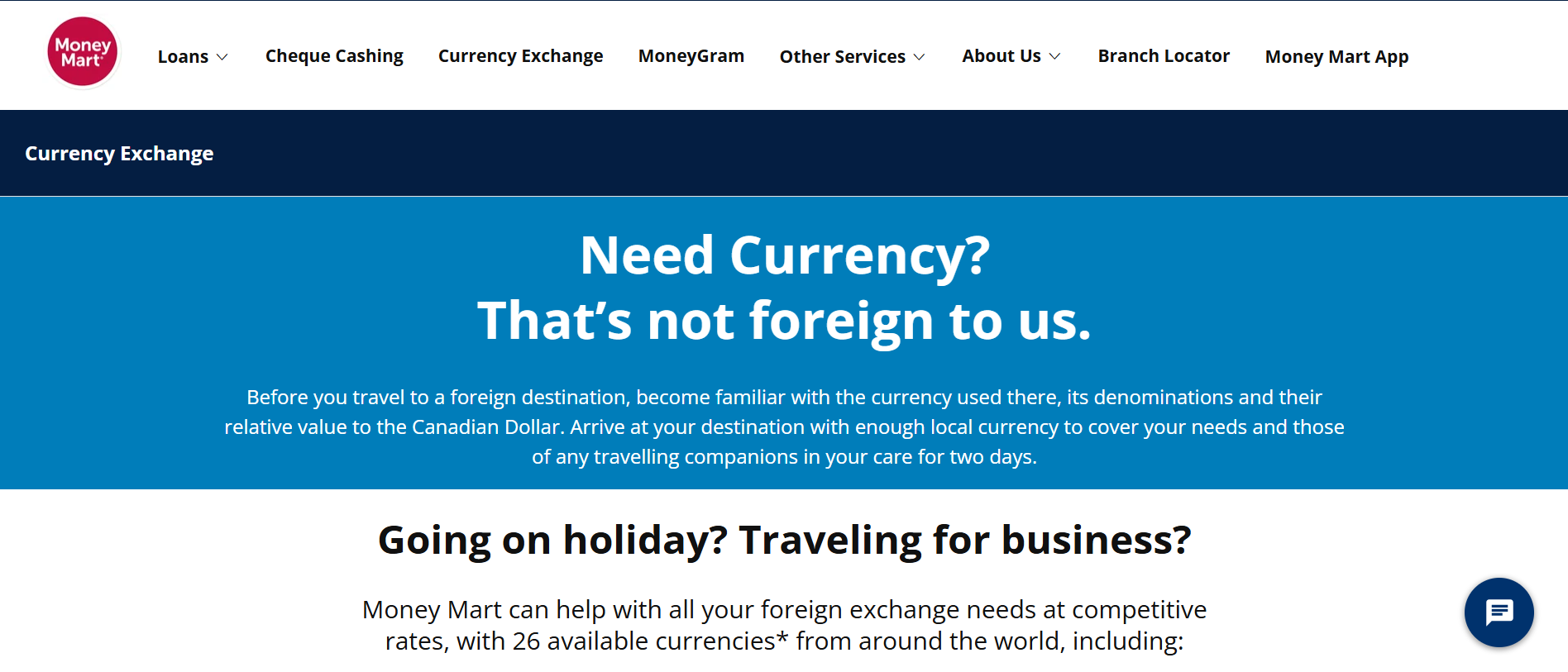
Money Mart is a retail financial services provider operating across Canada, primarily known for payday loans, cheque cashing, and short-term lending. Currency exchange is one of several services available at their physical locations, allowing customers to swap Canadian dollars for foreign currencies on the spot.
When you use Money Mart for currency exchange, you typically:
Don't Waste Money With Banks.
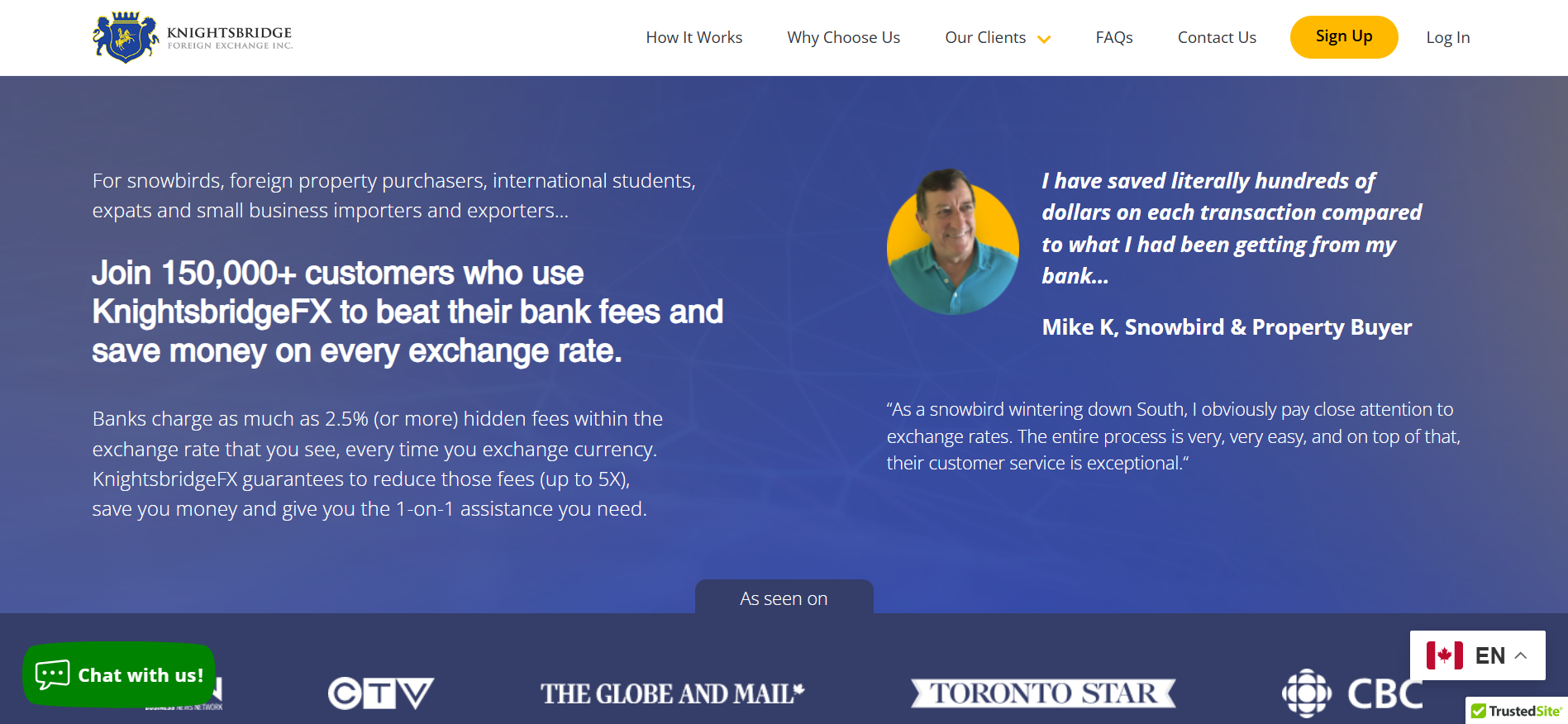
Get Exchange Rates Up to 2% Better With KnightsbridgeFX
- Bring cash or use a debit card
- Request a foreign currency like USD, EUR, or GBP
- Accept the quoted exchange rate
- Complete the transaction on the spot
This process appeals to customers who prioritize speed and accessibility. No pre-ordering, no waiting for bank transfers. For Canadians who need foreign cash quickly before a trip or to send money to family abroad, that immediacy can feel convenient.
That convenience comes at a cost.
The catch is that Money Mart’s business model is built around high-margin financial services. Their currency exchange rates include wide spreads above the true market rate, plus additional service fees that can cost you hundreds of dollars on larger exchanges.
Regulated currency exchange specialists like KnightsbridgeFX operate on a fundamentally different model. Rather than maximizing margins on each transaction, these providers focus on transparent, competitive rates that help you keep more of your money.
Understanding Money Mart’s currency exchange rates and fees
The rate posted at a Money Mart location isn’t the mid-market rate you’d find on a financial platform or the Federal Reserve’s G.5 report. Money Mart builds a markup directly into their exchange rate, creating a spread between the real market rate and what you actually receive. That spread is where a substantial portion of their profit comes from.
On top of the rate markup, you’ll typically face additional service fees. These can be percentage-based or flat charges, and they’re often not apparent until you’re mid-transaction. The combined effect of wide spreads and service charges means you could be losing hundreds of dollars on larger exchanges without fully realizing it.
How Money Mart’s exchange rates are determined
Like most retail currency exchange providers, Money Mart starts with the interbank rate—the wholesale rate at which major financial institutions trade currencies. From there, Money Mart sets its own exchange rates based on wholesale market rates, but it adds a markup. This markup can vary depending on:
- Currency demand (e.g., USD vs. less common currencies)
- Location (Toronto vs. smaller cities like St. Vital or Winnipeg)
- Transaction size
- In-store pricing policies
For example:
- The mid-market rate for CAD to USD might be 1.35
- Money Mart might offer you 1.40 or worse
That 0.05 difference may seem small, but on $5,000 CAD, you lose $250 instantly.
Unlike transparent FX specialists, which publish live rates online, Money Mart’s rates are often set at the branch level and can vary by location. You won’t find their rates on their website, which makes comparison shopping nearly impossible. Money Mart also maintains separate buy and sell rates for each currency, meaning you lose value both when converting CAD to foreign currency and when converting leftover cash back.
Service fees and potential hidden costs
Beyond the rate markup, Money Mart usually charges a flat service fee per transaction ranging from $3 to $10+. On a $200 exchange, a $5 fee adds another 2.5% to your total cost, on top of the already wide spread. These fees aren’t always prominently displayed, and many customers only discover them at the counter after they’ve already committed to the transaction.
Some locations also impose minimum or maximum exchange limits, which can force multiple transactions and multiple fees for larger amounts. Meanwhile, providers like KnightsbridgeFX show your exact rate and any applicable fees clearly before you commit. No surprises, no hidden charges.
How to exchange currency at Money Mart locations
If you need to use Money Mart for currency exchange, knowing what to expect can save you time, even if it won’t save you money compared to online alternatives.
Required documentation and identification
Money Mart requires government-issued photo ID for all currency exchange transactions. A valid driver’s license or passport will suffice. Like all Canadian currency exchange providers, Money Mart must comply with FINTRAC anti-money laundering requirements, so identity verification is mandatory above certain transaction thresholds.
For larger exchanges, you may also need to provide proof of address, contact information, and details about the purpose of your exchange. Call ahead to confirm exactly what documentation your specific transaction will require before making the trip.
Step-by-step exchange process
Here’s how a typical Money Mart currency exchange transaction works:
- Go to a Money Mart location: Visit a branch during business hours and tell the staff which currency you want to exchange.
- Get a quoted rate and fees: The staff will quote you a rate that includes a markup above the mid-market rate, along with any service fees.
Before agreeing, ask for the exact amount you will receive after all costs. - Confirm and complete the transaction: If you accept the rate, hand over your funds, and complete the required paperwork.
- Receive your cash: You will get your exchanged currency on the spot. The process usually takes a few minutes.
When exchanging with Money Mart, it’s important to remember:
- You are limited to branch hours and physical locations
- Rates are often 3% to 5% worse than regulated online providers
- You will be carrying physical cash, which adds security risk
Online currency exchange providers eliminate these issues by offering:
- Locked-in rates
- Bank-to-bank transfers
- Better pricing
- No need to visit a physical location
Money Mart currency exchange vs. other options
The difference between currency exchange providers can easily cost you hundreds of dollars on a single transaction. Here’s how Money Mart stacks up against banks, online platforms, and other options.
Banks and credit unions
Most major Canadian banks apply exchange rate markups of 2.5% to 4% above the mid-market rate, plus service fees ranging from $5 to $15 per transaction. On a $5,000 USD exchange, that markup alone can cost $125 to $200 before any additional charges. Banks also often require in-person visits for larger transactions, advance ordering of foreign currency, and restrict service to existing account holders.
Verdict: Money Mart’s rates are sometimes slightly better than banks’, but both options leave significant savings on the table compared to dedicated FX specialists.
Online currency exchange platforms
Regulated online platforms like KnightsbridgeFX operate with lower overhead than physical locations and pass those savings directly to you through tighter spreads and transparent pricing. Rates are typically 3% to 4% better than those of Money Mart currency exchange, with no hidden service charges on most transactions.
Beyond better rates, online platforms offer practical advantages that storefront services can’t match:
- 24/7 access to rate quotes and account management, so you can act when rates are favorable
- Transparent pricing with no surprise fees at the counter
- Direct bank transfers eliminate the risk of carrying large amounts of cash
- Secure digital records of all transactions for easy tracking
Most reputable online platforms are registered with FINTRAC and follow strict regulatory guidelines, giving you the same security and compliance as any established financial institution.
Verdict: If you’re exchanging more than a small amount, online platforms are almost always the more cost-effective choice.
Airport and hotel exchange services
Airport kiosks and hotel currency exchange desks are consistently the most expensive option available, with markups that can reach 10–15% above the mid-market rate. These services capitalize on traveler urgency, knowing you have limited alternatives in the moment.
Money Mart’s rates are considerably better than airport exchanges, but that’s a low bar. On a $1,000 USD exchange at an airport, you could easily lose $100–$150 compared to using a regulated online platform. The smarter move is to plan and exchange currency before you travel through a transparent provider.
Verdict: Airport and hotel exchanges should only be used as a last resort for small amounts.
Tips for getting the best currency exchange deal at Money Mart
If you’re already using Money Mart for currency exchange, a few practical steps can help reduce what you’re losing on each transaction. Though even with these strategies, you’ll still pay more than you would with a dedicated FX specialist.
- Compare rates before you commit. Money Mart’s rates vary by location and fluctuate throughout the day. Before heading to a branch, check the mid-market rate on a source like the Federal Reserve’s G.5 report so you know exactly how wide the spread is.
- Ask for a full fee breakdown up front. Don’t assume the posted rate is your total cost. Ask the staff to confirm exactly how much foreign currency you’ll receive after all fees are deducted. This prevents unpleasant surprises and makes it easier to compare the true cost against other providers.
- Consolidate your exchanges. If you travel regularly or send money abroad often, combining smaller exchanges into fewer, larger transactions reduces the impact of flat service fees. That said, you’re still paying Money Mart’s spread on every dollar exchanged.
- Weigh the convenience cost honestly. Immediate cash access has real value in urgent situations. But for most personal currency exchange needs, saving on currency exchange through a secure online provider delivers better rates without requiring a branch visit or cash handling.
Make the smart decision for your currency exchange
The provider you choose for currency exchange directly impacts how much money you keep. While convenience matters, it should not come at the cost of higher rates and hidden fees.
For most Canadians, the better option is simple. Choose a provider that offers transparent pricing, competitive rates, and secure wire transfers without the need to handle cash.
KnightsbridgeFX delivers exactly that. With rates that consistently beat Money Mart and the banks, no hidden fees, and secure bank-to-bank transfers, you know exactly what you’re getting before you commit.
If you are exchanging more than a small amount, switching to KnightsbridgeFX can save you hundreds of dollars on a single transaction.
Sign up today and see how much you could save in just a few clicks.

 AUD
AUD CAD
CAD EUR
EUR GBP
GBP NZD
NZD USD
USD
