
You wired money through Simplii Financial, paid the posted fee, and watched the recipient flag that less than expected arrived. Or you sent $20,000 abroad and only later realized the exchange rate baked in a cost bigger than the wire fee itself. That gap between what Simplii’s website lists and what your transfer actually costs is the part most people don’t see coming. Intermediary deductions, foreign exchange (FX) spreads, and the way you set up the transfer all change the final number, often by hundreds of dollars on a single send.
This guide breaks down every Simplii wire transfer fee, explains why the true cost is often higher, and shows you how to keep more on every transfer.
Simplii wire transfer fees at a glance
Simplii Financial, the direct banking division of CIBC, charges wire transfer fees on a tiered basis. The amount you pay depends on the size of the transfer, the currency of your account, and whether you’re sending or receiving funds. Below is the official Simplii wire transfer fee schedule, taken directly from Simplii’s legal terms.
Outgoing wire transfer fee tiers (Canadian dollar accounts)
Simplii charges outgoing wire transfer fees in three tiers based on the Canadian dollar (CAD) equivalent of your transfer funds:
- Wire transfer equivalent to CAD $10,000 or less: $30
- Wire transfer equivalent to CAD $10,000.01 to $50,000: $50
- Wire transfer equivalent to greater than CAD $50,000: $80
If you’re sending from a foreign currency account, the fee is charged in that account’s currency at a roughly equivalent amount.
A separate fee applies if anything goes wrong after the transfer leaves Simplii. The Wire Payment Investigation, Recall, Trace, or Amend fee is $35 CAD per investigation, and correspondent banks may add their own charges on top. This fee can apply to both incoming and outgoing wires.
Don't Waste Money With Banks.
Get Exchange Rates Up to 2% Better With KnightsbridgeFX
Incoming wire fees: What Simplii charges and what CIBC deducts
Receiving a wire transfer through Simplii also carries a fee. Simplii charges $10 CAD for an incoming wire from another financial institution, with the same caveat that any correspondent bank involved may levy additional charges before funds reach your account. There’s also a separate fee for CIBC Inter-Branch Payments at $20 per payment, since Simplii is a division of CIBC.
That means a $10 fee at the Simplii level plus an unknown amount of correspondent deductions you can’t see in advance, which is why incoming wires often arrive short by more than the posted fee alone would suggest.
Why your wire transfer may cost more than the posted fee
The Simplii wire transfer fee on the website is one layer of cost. There are at least two more layers most senders don’t notice until the transfer is complete: charges added by other banks in the routing chain, and the exchange rate applied to any currency conversion.
Intermediary and correspondent bank deductions
International wires rarely move directly from sender to recipient. They pass through one or more intermediary banks, sometimes called correspondent banks, before reaching the final destination. Each one can deduct a fee from the transfer amount, typically $10 to $25 U.S. dollars per stop.
Simplii acknowledges this explicitly in its terms: any correspondent bank involved “may levy additional charges, in addition to the investigation fee.” Neither Simplii nor you control which banks sit in the routing chain or what they charge, which is why two senders moving the same amount on the same day can end up with different deposits at the other end.
Foreign exchange (FX) spread and currency conversion costs
If your transfer involves any currency conversion, the exchange rate applied is almost always the largest part of the total cost. Simplii’s terms confirm the bank earns money on the spread between the bid and ask prices of the currency, in addition to any fee you pay on the transaction.
Most Canadian banks build an FX margin of 2% to 4% above the mid-market rate (the real interbank rate you can verify against the Bank of Canada’s daily exchange rates). On a $25,000 CAD conversion to USD at a 2.5% spread, that’s $625 disappearing into the rate itself. None of that shows up as a line-item fee, which is why a transparent currency exchange provider can often save more than shopping wire fees.
OUR, SHA, and BEN fee arrangements: What each means for you
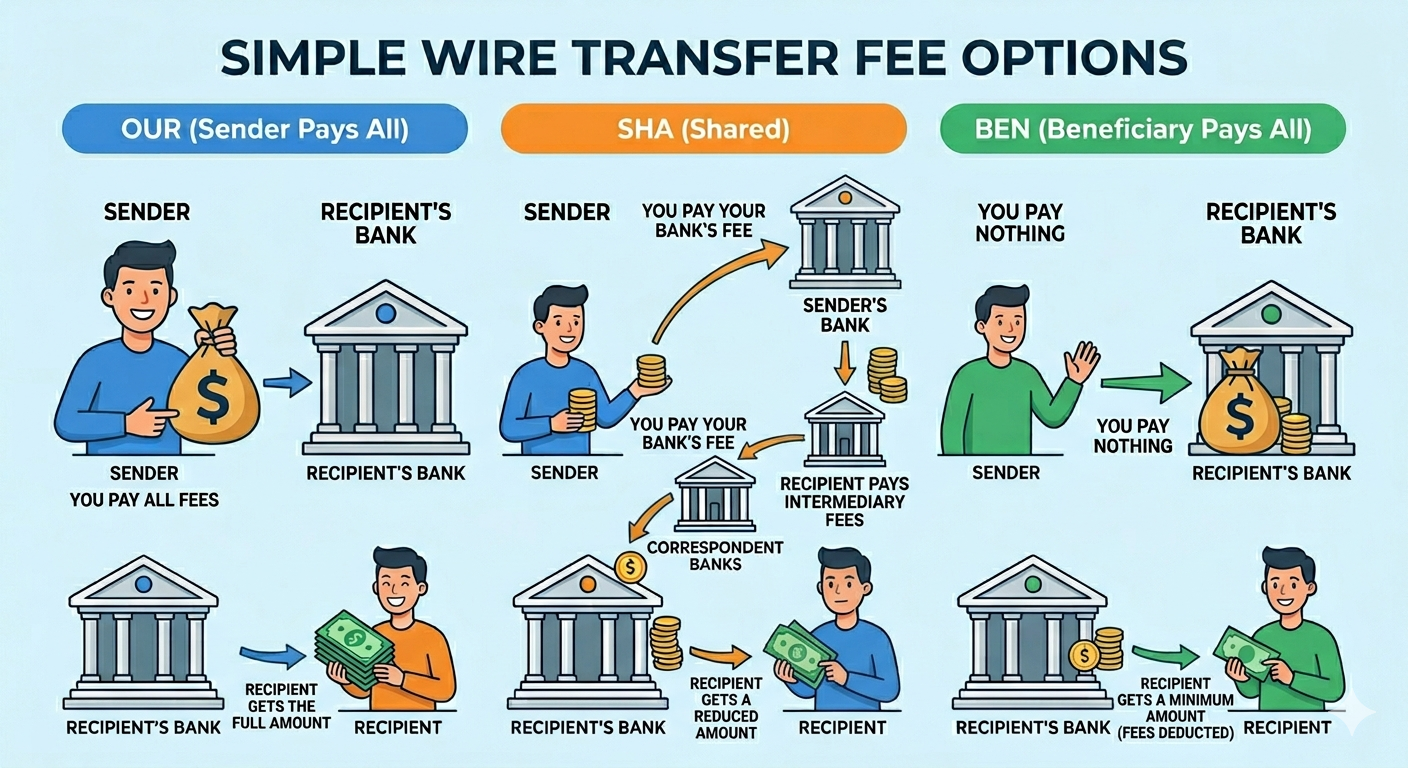
When you initiate a wire transfer, the way fees are allocated between sender and recipient is set by a fee instruction code:
- OUR: You, the sender, pay all fees including correspondent bank charges. The recipient receives the full transfer amount. Simplii’s “free and clear of all charges” designation is the equivalent of OUR.
- SHA (shared): You pay your own bank’s fee. The recipient pays any correspondent and receiving bank fees. This is the default for most personal wires and explains why amounts arrive short.
- BEN: The recipient pays all correspondent and beneficiary bank fees, deducted from the transfer amount itself.
Unless you designate a transfer as “free and clear of all charges” (OUR), Simplii and its correspondents are authorized to deduct unpaid fees before crediting the beneficiary. Most personal wires default to a SHA-style arrangement, with correspondent deductions reducing what lands on the other side.
Simplii wire transfer vs. Simplii global money transfer: Key differences
Simplii Financial offers two distinct ways to send money internationally, and they’re easy to confuse. A wire transfer and the Simplii Financial Global Money Transfer (GMT) service have different cost structures and use cases.
GMT is built for personal remittances and small-to-medium international transfers. According to Simplii, it has:
- No transfer fees or deductions
- Supports sends of up to $75,000 CAD in a 24-hour period
- Reaches 130+ countries
The minimum send amount is $100 CAD. Funds can move to a recipient’s local currency or, in some cases, to USD.
Wire transfers are more flexible but more expensive, and they:
- Work for amounts above the GMT cap
- Support a wider range of destination currencies and bank account types
- Are often required for business transactions, real estate closings, or any payment where the recipient’s institution doesn’t participate in Simplii’s GMT network
Choose GMT for personal sends under $75,000 to a supported country. Choose a wire when the destination or amount falls outside those limits. Either way, Simplii’s FX spread on the conversion is still part of the total cost.
Transfer limits, processing times, and how to send or receive a wire with Simplii
Wire transfers through Simplii follow a defined process. Most transfers settle within one to three business days for domestic and three to five business days for international, though correspondent bank delays can extend that timeline.
Sending a wire: required details and step-by-step process
To send an outgoing wire, you’ll need the following information about the recipient:
- Full legal name and address (matching the account holder information exactly)
- Recipient bank name and full address
- Bank account number or IBAN (for European destinations)
- SWIFT/BIC code of the recipient bank
- Currency and amount to be sent
- Intermediary bank details (if required by the destination)
- Reason for the transfer (often required for compliance)
Once you have the details:
- Sign in to Simplii Online Banking and locate the wire transfer request option, or contact Simplii by phone.
- Enter the recipient and bank details exactly as the receiving bank requires. Errors here are the most common reason for delays or returns.
- Choose your fee arrangement. If the recipient needs to receive the full amount, designate the transfer as “free and clear of all charges.”
- Confirm the exchange rate, if applicable, before submitting. The rate you accept locks in Simplii’s FX spread for that transfer.
- Submit and retain the confirmation. Wire transfers cannot be cancelled once processed, so double-check every field before confirming.
Receiving a wire: What information to give the sender and how to avoid returns
To receive an incoming wire, the sender needs your full Simplii Financial banking service details. Provide them in writing to reduce transcription errors:
- Your full legal name and address (matching what Simplii has on file)
- Simplii Financial bank name and address
- Your Simplii account number
- Simplii’s SWIFT/BIC code
- The CIBC institution number (010), since Simplii is a division of CIBC
If any detail is incorrect, the wire can be returned, delayed, or held for investigation. Returned wires can trigger the $35 investigation fee plus any correspondent bank charges.
Once the wire arrives, Simplii deducts its $10 incoming fee plus any correspondent charges already taken in the routing. Funds typically appear within one business day of Simplii receiving them, though incoming international wires can take three to five business days end-to-end.
How to reduce your total transfer cost and when to consider an alternative
The full cost of a Simplii wire transfer in Canada depends on more than the fee schedule. A few practical ways to lower it without changing providers:
- Match the currency of your account to the currency of the transfer. Sending USD from a Simplii USD Savings Account avoids the FX spread entirely.
- Choose the right fee arrangement. If the recipient needs an exact amount, designating the transfer as “free and clear of all charges” prevents correspondent banks from quietly reducing the deposit.
- Confirm the recipient’s banking details twice. A returned or recalled wire triggers a $35 investigation fee plus possible correspondent charges.
- Use Global Money Transfer for personal sends under $75,000. If the destination is supported, GMT has no transfer fee, though the FX margin still applies.
- Time large currency conversions strategically. The Bank of Canada publishes daily mid-market rates. If you’re converting more than $10,000 and the timing is flexible, monitoring the rate for a few days can save more than any fee shopping.
When the transfer involves significant currency conversion, a dedicated FX provider almost always delivers a better total cost than a bank-routed wire. KnightsbridgeFX, a Canadian-based currency exchange specialist, has helped over 150,000 Canadians save since 2009, holds an A+ rating with the Better Business Bureau, is registered with FINTRAC, and was featured on Dragons’ Den. For transfers involving CAD-to-USD or other currency conversions above $10,000, it’s worth running a parallel quote.
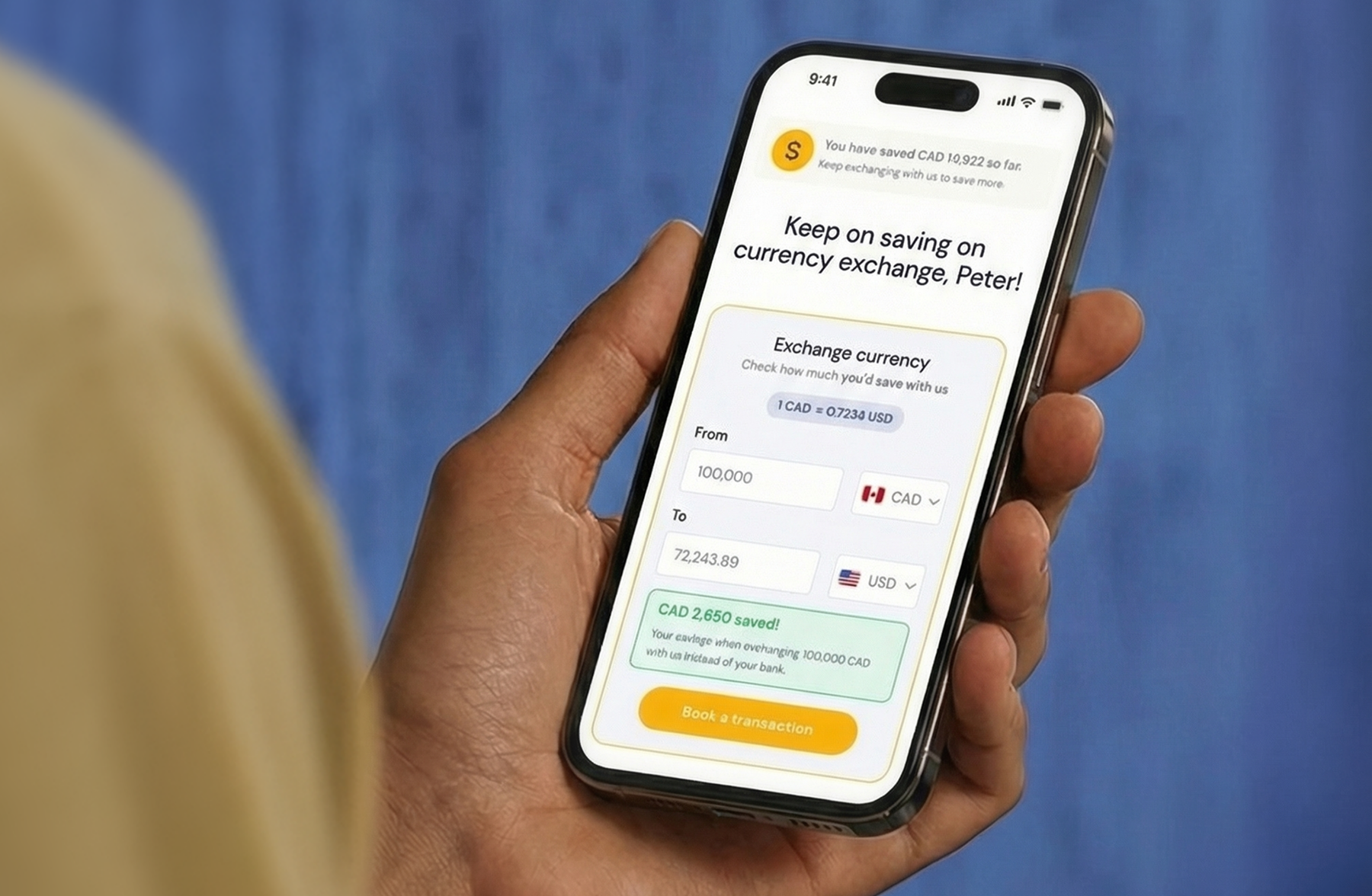
Get more out of every transfer
The Simplii wire transfer fee on its website is only the start of what a transfer really costs. Intermediary deductions and FX spreads can quietly multiply the price tag.
You can’t always avoid wire transfers, but you can avoid overpaying on the exchange rate side. When currency conversion is part of the money transfer service, that’s where the biggest savings are usually waiting.
Join over 150,000 Canadians who avoid hidden bank markups and sign up for a free KnightsbridgeFX account to secure exchange rates that consistently beat Simplii’s.
Frequently asked questions about Simplii wire transfer fees
Does Simplii charge a fee to receive an incoming wire transfer?
Yes, Simplii charges $10 CAD to receive an incoming wire from another financial institution, deducted before funds are credited to your account. Any correspondent bank in the routing may levy its own charges on top, which Simplii doesn’t control. Inter-branch payments from CIBC are charged separately at $20 per payment.
Why did my incoming wire arrive short by $10 or more?
The $10 difference is typically the Simplii incoming wire fee. Anything beyond that usually comes from correspondent bank deductions applied somewhere along the routing chain. If the sender used a SHA fee arrangement (the default for most personal wires), those correspondent charges came out of the transfer amount. To receive the full amount, the sender would need to designate the transfer as “free and clear of all charges” at their bank.
Is Simplii global money transfer the same as a wire transfer?
Simplii’s Global Money Transfer (GMT) and a wire transfer are not the same. GMT is a fee-free service for personal remittances with a maximum amount of $75,000 CAD in a 24-hour period, reaching 130+ countries. A wire transfer is more flexible, supports any amount and any SWIFT-connected destination, and charges $30 to $80 per outgoing send. Both apply Simplii’s FX spread to currency conversions, so the absence of a transfer fee on GMT doesn’t mean the transfer is free overall.

 AUD
AUD CAD
CAD EUR
EUR GBP
GBP NZD
NZD USD
USD
