
Most Canadians use currency exchange services without fully understanding how exchange rates work. You check a rate online, visit your bank or a foreign currency exchange provider, and receive a different rate than the one you expected.
That difference is not random.
Every time you convert currency, whether from the Canadian dollar to U.S. dollars, GBP, JPY, Australian dollars, or another foreign currency, the exchange rate determines how much money you receive. What many people don’t realize is the rate shown by a currency converter is often different from the rate offered by banks, financial institutions, and other providers.
Understanding how currency exchange works helps you spot hidden costs, compare providers more effectively, and keep more of your money when making international payments, travelling abroad, or moving funds between countries.
What is currency exchange?
Currency exchange is the process of converting one currency into another. Also known as foreign currency exchange, it allows individuals, businesses, and governments to buy and sell different currencies for travel, investing, international trade, and international payments.
The value of one currency compared to another is called the exchange rate.
Don't Waste Money With Banks.
Get Exchange Rates Up to 2% Better With KnightsbridgeFX
For example, if one Canadian dollar is worth 0.73 U.S. dollars, the exchange rate between the Canadian dollar and the USD is 0.73. If you exchange $1,000 CAD at that rate, you would receive approximately $730 USD before any fees, commission, or markup.
While the process seems simple on the surface, exchange rates constantly move based on economic conditions, supply and demand, and activity in the foreign exchange market. Those factors ultimately determine how much foreign currency your money can buy.
How exchange rates are set
Exchange rates move constantly. The rate this morning won’t be the rate this afternoon, and the reason comes down to a massive global market where currencies trade against each other every second.
Currency pairs
Currencies always trade in currency pairs because one currency only has value relative to another.
In every currency pair, the first currency is the base currency and the second is the quote currency.
For example:
- USD/EUR shows how many euros one U.S. dollar can buy.
- USD/CAD shows how many Canadian dollars one U.S. dollar can buy.
- CAD/USD shows how many US dollars one Canadian dollar can buy.
- GBP/JPY shows how many Japanese yen one British pound can buy.
If CAD/USD trades at 0.73, one Canadian dollar purchases 73 US cents. If USD/CAD trades at 1.37, one U.S. dollar purchases 1.37 Canadian dollars.
Currency pairs form the foundation of all currency exchange transactions. Every time you convert currency, you are effectively buying one currency while selling another.
What moves exchange rates
Rates shift because supply and demand for each currency shift. Several forces push and pull at them throughout the day:
- Interest rates. When a country’s central bank, like the Bank of Canada, raises rates, its currency often strengthens because higher returns attract investment.
- Inflation. Lower, stable inflation tends to support a currency’s value over time.
- Economic data. Employment numbers, growth figures, and trade balances all feed into how strong a currency looks.
- Commodity prices. The Canadian dollar is closely tied to oil and other resources, so swings in commodity markets move the loonie.
- Market sentiment. Political events, global uncertainty, and investor confidence can shift rates quickly, sometimes within minutes.
No single factor controls the rate. They interact, which is why exchange rates are impossible to predict with certainty and why the number genuinely changes from one day to the next.
The rate you see vs. the rate you get
Here’s the part that surprises most people. The rate you look up online is rarely the rate you receive when you exchange money. Understanding why is the single most useful thing you can take from this guide.
Mid-market rate
The rate you see on Google or in the news is the mid-market rate, also called the interbank rate. It sits exactly in the middle between what buyers are willing to pay and what sellers are willing to accept, and it’s the rate large banks use when they trade with each other.
The Bank of Canada publishes indicative daily exchange rates built from these mid-market quotes, which makes it a clean benchmark for what a currency is truly worth. The catch is that ordinary consumers rarely get this rate. It’s the wholesale price, not the retail one.
Spread and markup
The difference between the mid-market rate and the rate you’re actually offered is the spread. This is where banks and many providers quietly make their money.
Instead of charging you an obvious fee, they hand you a slightly worse rate than the real one and keep the difference. A Canadian bank might add a margin of two to three per cent on top of the mid-market rate. On a $10,000 exchange, that’s $200 to $300 gone, and you never see a line item explaining it.
That’s what makes the spread so easy to miss. It looks like you simply got “the rate,” when in reality the cost was folded into the number before it ever reached you.
Flat fees vs. percentage fees
On top of the spread, providers sometimes charge separate fees, and they come in two shapes:
- Flat fees are a fixed amount per transaction, say $10 regardless of how much you exchange. These hurt small exchanges most, since $10 on a $200 conversion is a steep five per cent.
- Percentage fees scale with the amount. A common example is the 2.5 per cent foreign transaction fee most Canadian credit cards add on purchases made in another currency, charged on top of the network’s exchange rate.
When you compare providers, you have to look at both the spread baked into the rate and any fees stacked on top. Only together do they tell you the true cost.
Where Canadians can exchange currency
Canadians have several ways to exchange money, and they differ a lot in how close they get you to that mid-market rate.
- Major banks (RBC, TD, Scotiabank, BMO, CIBC). Convenient and familiar, but their rates usually carry a spread of two to three per cent or more above the mid-market rate. You’re paying for the branch and the brand.
- Currency exchange kiosks. The booths in airports and tourist areas offer instant cash, but their margins are often the widest of all, sometimes well above three per cent.
- Online FX providers. Specialized services operate with lower overhead and far more transparent pricing, which lets them offer rates much closer to the mid-market rate.
This last group is where a Canadian specialist like KnightsbridgeFX sits. As a Canadian company that works specifically with Canadians and Canadian banks, KnightsbridgeFX uses volume-based pricing to stay close to the mid-market rate, with no hidden markup buried in the number. For anyone exchanging more than a few hundred dollars, the difference against a bank rate adds up fast.
How to get a better exchange rate
Once you know where the cost hides, getting a better exchange rate becomes a matter of a few simple habits:
- Check the real rate first. Look up the mid-market rate for Bank of Canada or a tool like xe.com before you exchange, so you have a benchmark to judge any offer against.
- Watch the spread, not just the fees. A provider that advertises “no fees” can still bury its margin in the rate. Compare the rate you’re offered to the mid-market rate to see the true cost.
- Avoid airport and hotel kiosks. Their convenience comes with the worst rates you’ll find. Exchange before you travel or use a better provider.
- Time larger exchanges. Rates move daily, so for a big conversion, it can pay to watch the market for a few days rather than exchanging the moment you decide.
- Use a specialist for bigger amounts. The larger the exchange, the more a tighter rate matters. A dedicated currency exchange provider saves you more on $20,000 than it ever could on $200.
None of this requires special expertise. It just requires knowing the rate exists and checking it before you commit.
Making your money go further every time you exchange
Once you understand the spread, “getting a good rate” stops being luck. It becomes a choice.
The reason most Canadians overpay isn’t carelessness. It’s that the cost is designed to be invisible, folded into a rate that looks perfectly normal. The moment you start comparing any offer against the mid-market rate, the markup has nowhere to hide, and you can pick the provider that keeps the most money in your pocket.
That’s the whole point of understanding how currency exchange works. You stop accepting whatever number you’re handed and start choosing where you exchange based on what it actually costs you.
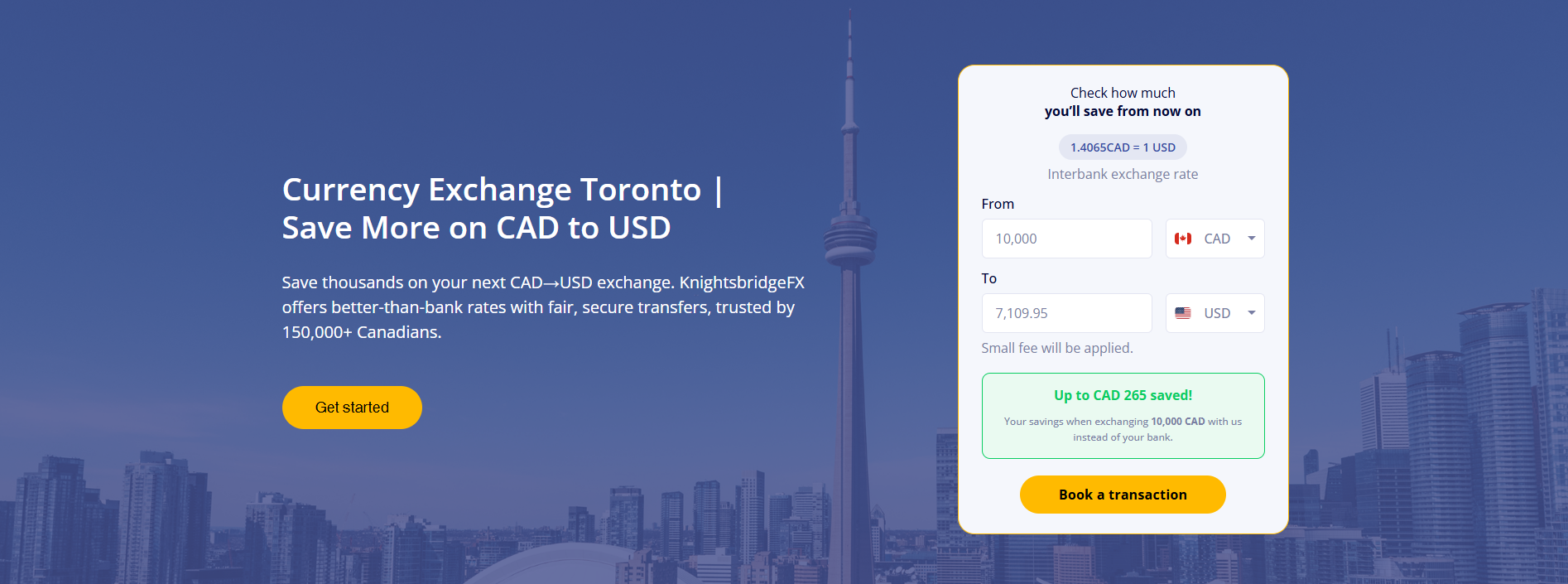
KnightsbridgeFX is built around that idea. A Canadian company featured on CBC’s Dragons’ Den, registered with FINTRAC, and rated A+ by the Better Business Bureau, it has helped more than 150,000 Canadians exchange currency at rates that stay close to the mid-market, without the hidden bank markup. You can verify everything independently, and you can start with a small test transaction to see how it works before moving anything larger.
Put what you’ve learned to work. Open a free KnightsbridgeFX account and exchange at rates that stay close to the mid-market, with no hidden bank markup eating into your money.
Frequently asked questions about currency exchange
What is the mid-market exchange rate?
The mid-market rate is the midpoint between the buying and selling prices of a currency, and it’s the rate banks use when they trade with each other. It’s the number you usually see on Google or financial news sites. Most consumers don’t actually receive it because banks and providers add a margin, called the spread, on top before offering you a rate.
Why is the exchange rate I get worse than the one online?
The rate online is the mid-market rate, a wholesale benchmark. The rate you’re offered includes a markup that the bank or provider keeps as profit. This spread is usually built into the rate rather than shown as a fee, so it’s easy to miss. Some providers also add flat or percentage fees on top, widening the gap further.
When is the best time to exchange currency?
There’s no perfect time, because rates move with markets that no one can predict. For small amounts, the timing rarely matters enough to wait. For large exchanges, watching the rate over several days can help you avoid a bad day, and using a provider that stays close to the mid-market rate makes far more difference than trying to time the market precisely.

 AUD
AUD CAD
CAD EUR
EUR GBP
GBP NZD
NZD USD
USD
