

You asked your bank what it charges to exchange currency and got a vague answer. Or you saw “no fee” advertised and sensed a catch. Your instinct is right: when it comes to what banks charge for currency exchange, the number they show you is rarely the full story.
Most of the cost never appears on a statement, a receipt, or a fee schedule. It lives somewhere most people never think to look.
This guide breaks down where the real costs sit in your bank’s foreign exchange services, how the major Canadian banks compare, the extra charges that pile onto everyday cross-border spending, and how to pay less. One note before we start: rates and fees change regularly, so the figures below reflect general fee structures rather than live quotes.
What do banks charge for currency exchange?
Most Canadian banks build a spread of 2% to 3.5% into their exchange rate across transfer methods, such as wire transfers or automated clearing house (ACH) transfers, and that spread never appears as a fee on any statement. It’s the gap between the rate banks trade at and the rate they give you, and it’s where nearly all of their currency exchange profit comes from.
At the personal-expenses scale, the numbers get real quickly. A 2.5% spread on a $10,000 exchange costs $250, and the receipt shows nothing.
The mid-market rate vs. the rate your bank offers
Every currency pair has a mid-market rate, which is the midpoint between the buy and sell prices on the global market. It’s the rate you see when you search a pair on Google or check a currency converter like XE, and it’s the rate banks use when they trade with each other.
Don't Waste Money With Banks.
Get Exchange Rates Up to 2% Better With KnightsbridgeFX
But you don’t get that rate. When you exchange Canadian dollars for United States dollars (USD), euros (EUR), or any other foreign currency, your bank quotes you a retail rate with its margin already baked in. The spread is the difference between the two, and banks typically build 2% to 3% into their exchange rates this way.
How the spread works in practice
Say the mid-market rate is 1 USD = 1.4000 Canadian dollars (CAD), and your bank sells USD at 1.4350. That’s a 2.5% spread. Converting $10,000 CAD gets you about $6,969 USD instead of the $7,143 USD the mid-market rate would give you, a difference of roughly $174 USD, or about $244 CAD.
Nothing on your confirmation calls this a fee. The transaction just shows the rate you accepted, which is why most people never notice what they paid.
Currency exchange fees at Canada’s major banks
The Big Five all price currency exchange the same way, through the rate. The differences between them are real but modest, and all of them sit well above the mid-market rate.
Typical exchange rate spreads by bank
Here’s how the major Canadian banks compare on typical observed CAD/USD markups. Spreads move daily and vary by amount and channel, so treat these as representative snapshots rather than live quotes. Our ongoing bank rate comparisons track them over time.
| Bank | Typical observed markup | Approximate cost on a $10,000 exchange |
| RBC | ~2.3% | ~$230 |
| TD | ~2.6% | ~$260 |
| BMO | ~2.7% | ~$270 |
| Scotiabank | ~2.9% | ~$290 |
| CIBC | ~3.3% | ~$330 |
It should be noted that credit unions may offer members slightly better rates. But most rely on the same wholesale providers as the banks, so the savings are usually modest. For a deeper look at any single bank, our RBC exchange rate breakdown shows how to read one bank’s pricing line by line.
Cash vs. non-cash exchange rates
Banks quote two sets of foreign exchange rates, and the difference surprises most people. Cash rates apply when physical banknotes change hands. Non-cash rates apply to electronic and paper instruments:
- Wire payments
- Drafts
- Cheques
- Account-to-account conversions
Cash rates are consistently worse. Scotiabank explains it plainly, stating that acquiring and handling physical cash costs more, so the exchange rates for cash transactions are higher than non-cash. Banknotes have to be shipped, insured, stored, and counted, and the bank prices all of that into the rate. If you can exchange electronically instead of in bills, you’ll get the better side of the rate sheet.
Foreign cash orders and delivery charges
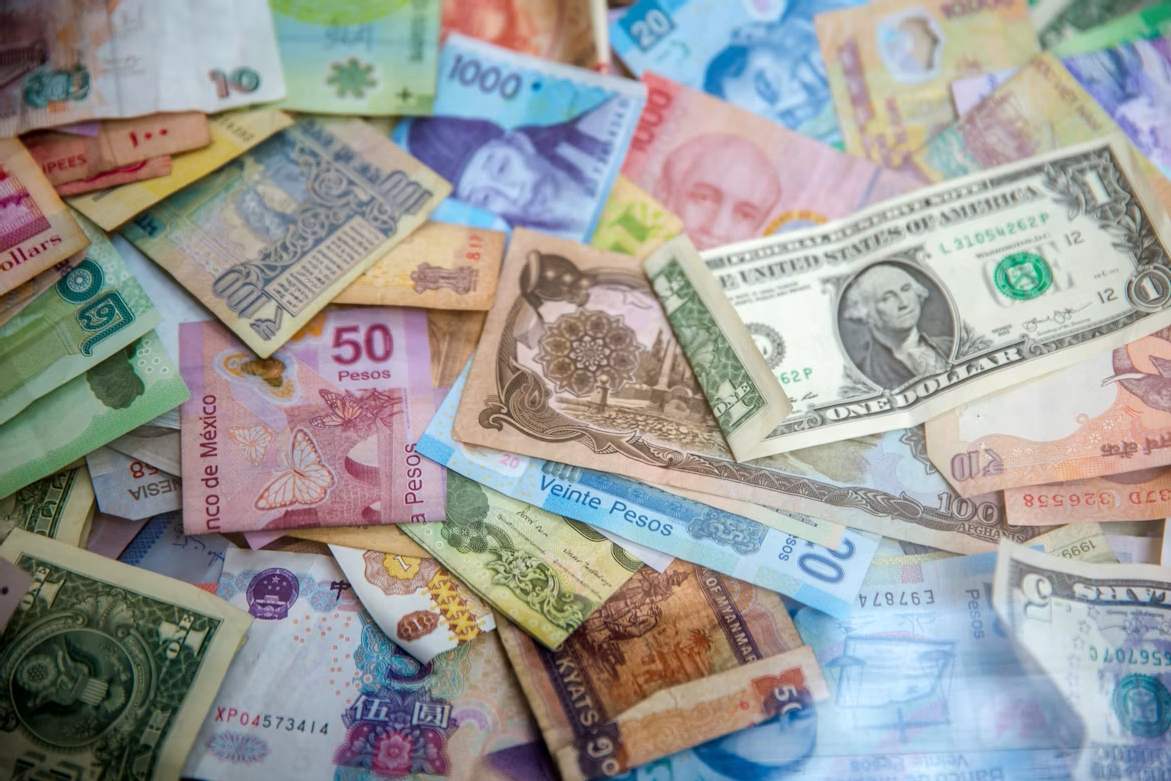
Ordering foreign cash through your bank adds a convenience layer with its own costs. Most major banks let you order online for branch pickup, with RBC offering over 40 currencies and pickup typically within three business days. The exchange rate on these orders is the cash rate, markup included, so the cost is already in the price before any service charges appear.
However, delivery policies vary. Some banks deliver foreign cash to your home free, while others charge a courier fee of around $10. Watch one trap in particular: paying for a foreign cash order with a credit card can be treated as a cash advance, which triggers fees and immediate interest.
The other fees that add up when you exchange money
Beyond the spread, three charges hit everyday cross-border spending. Each one is avoidable once you know where it applies.
- Foreign transaction fees on credit and debit cards. Most Canadian cards add a surcharge, typically 2.5%, to every purchase made in a foreign currency, on top of the conversion itself. The sidestep: carry a card with no foreign transaction fees for travel and online shopping in other currencies.
- ATM withdrawal fees abroad. Withdrawing cash outside Canada stacks a flat operator fee, your own bank’s foreign ATM charge, and the rate markup, and the flat fees bite hardest on small withdrawals. The sidestep: withdraw once in a larger amount from a bank-owned machine rather than several times in small ones.
- Dynamic currency conversion (DCC). When a terminal or ATM abroad offers to charge you in Canadian dollars, the conversion happens at the merchant’s rate with a significant markup built in, and your card’s foreign transaction fee usually still applies on top. The sidestep: always pay in the local currency and let your card network convert.
How to pay less for currency exchange
You can’t opt out of exchange costs entirely, but you can control how much of the spread you pay.
Compare the full rate, not the posted fee
A “no fee” exchange with a 3% markup costs far more than a $15 service charge at a sharp rate. Before committing:
- Check the mid-market rate
- Compare it to the rate you’re offered
- Express the gap as a percentage
Doing so can expose the true cost of any provider in under a minute.
Choose how and where you exchange carefully
Exchange electronically rather than in cash where possible, pay in local currency whenever a terminal offers the choice, and make fewer, larger exchanges instead of many small ones so flat service charges get spread across more dollars. For the complete playbook, see our 10 ways to save on currency exchange.
Use a currency exchange specialist for larger amounts
The bigger the amount, the more the spread matters, and the stronger the case for skipping the bank entirely and using an exchange specialist instead.
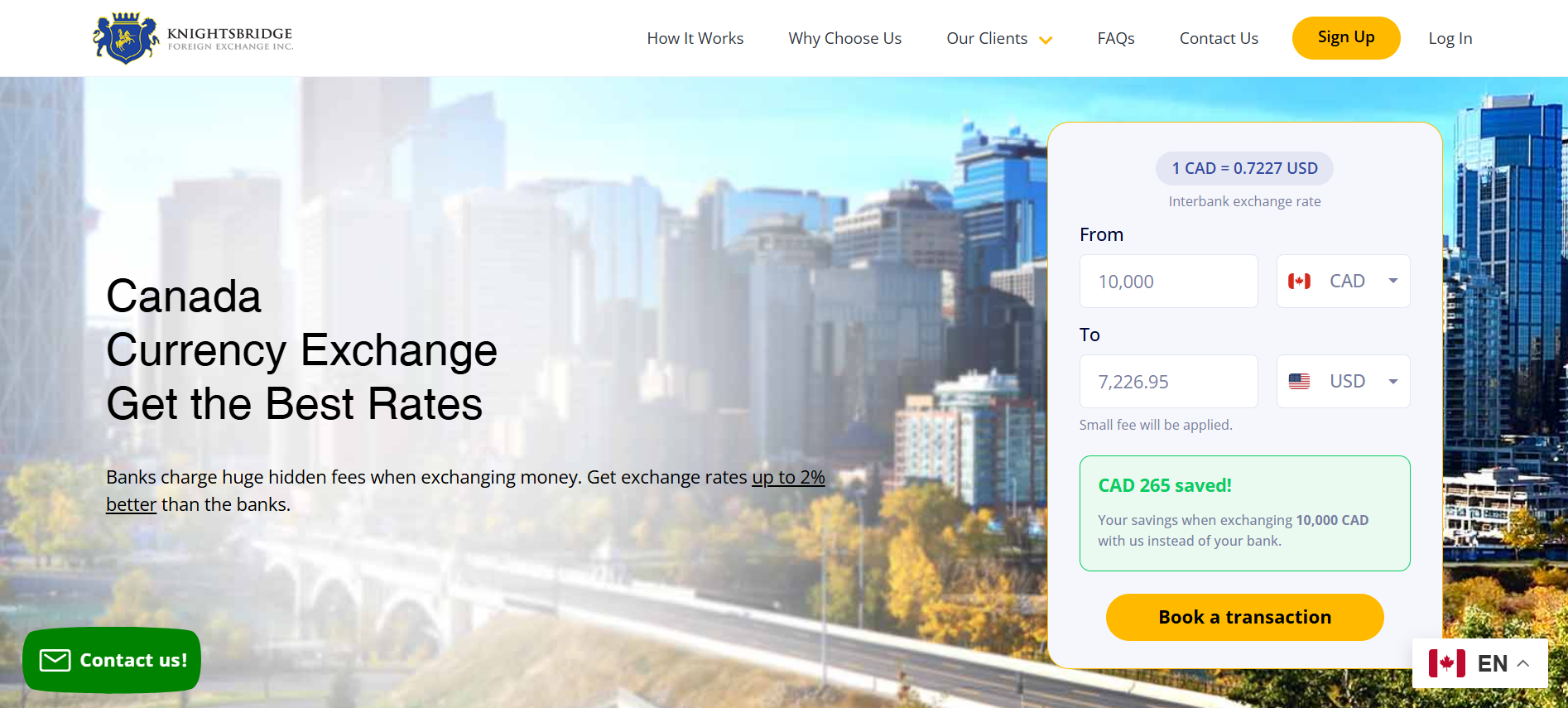
KnightsbridgeFX offers currency exchange for Canadians at rates typically 1.5% to 2.5% better than the banks, backed by a Best Rate Guarantee and daily bank-rate checks, with no hidden fees and free wire transfers on exchanges ($2,000 minimum). On a $10,000 conversion, a 2% saving is $200 back in your pocket on a single transaction.
When your bank is still the right choice
Honestly, banks win in a few situations:
- If you need small cash amounts, the convenience of walking into a branch and leaving with foreign banknotes can be worth more than saving a few dollars with a better rate.
- If you value one-stop banking, keeping your currency exchange where your accounts already live has real appeal.
- If you hold foreign currency accounts, such as a USD account for regular cross-border expenses, your bank makes managing those balances straightforward.
The general rule is simple: the larger the amount, the more the spread matters and the stronger the case for a specialist. Exchanging $300 for a weekend trip? Your bank is fine. Converting $10,000 or more? The spread is now the biggest number in the transaction, and it’s better to look at alternatives.
Stop paying the bank’s hidden markup
So what do banks charge for currency exchange? Mostly, they charge a 2% to 3.5% spread built into the exchange rate, plus foreign transaction fees, service charges, and cash-handling premiums around the edges—and the rate is where the money moves.
KnightsbridgeFX challenges that. We’re a Canadian company founded over 15 years ago, registered with FINTRAC, holding an A+ rating with the Better Business Bureau, and trusted by over 150,000 customers. Getting started takes minutes: get a quote, lock your rate, and transfer securely.
Avoid what banks charge for currency exchange, and open a free KnightsbridgeFX account to get rates that beat them every time, with no hidden fees.
Frequently asked questions about bank currency exchange fees
Do banks charge a fee to exchange currency?
Banks do charge a fee to exchange currency, but it’s rarely visible. Canadian banks make most of their currency exchange revenue through the spread, a 2% to 3.5% markup built into the exchange rate itself, which never appears as a line item. Some transactions add explicit charges on top, such as wire transfer fees for international transfers, courier charges on foreign cash delivery, or foreign transaction fees on card purchases. The advertised “fee” is usually the smallest part of what you pay.
Why is my bank’s exchange rate different from the rate on Google?
The rate on Google is the mid-market rate, or the wholesale rate banks use when trading with each other. Your bank quotes a retail rate with its markup already included, typically 2% to 3.5% away from mid-market. The gap between the two is the bank’s profit on the conversion. Comparing your bank’s quoted rate against the mid-market rate at the same moment is the fastest way to see exactly what you’re being charged.
Which Canadian bank has the lowest currency exchange fees?
The differences between major Canadian banks are modest, and all sit within roughly the same 2% to 3.5% spread range. RBC and TD often show slightly tighter CAD/USD markups, while CIBC’s tend to run higher, but the ranking shifts daily. Currency exchange specialists offer the lowest rate, offering between 1.5% to 2.5% lower than most banks.
Is it cheaper to exchange money at a bank or a currency exchange service?
For larger amounts, a dedicated currency exchange service is usually cheaper because it operates on a thinner spread than banks. Specialists like KnightsbridgeFX typically beat bank rates by 1.5% to 2.5%, which means $150 to $250 saved on a $10,000 exchange. For small cash amounts, the difference shrinks to a few dollars and a bank branch may be more convenient. Compare the offered rate against the mid-market rate in both cases and let the total cost decide.

 AUD
AUD CAD
CAD EUR
EUR GBP
GBP NZD
NZD USD
USD
