
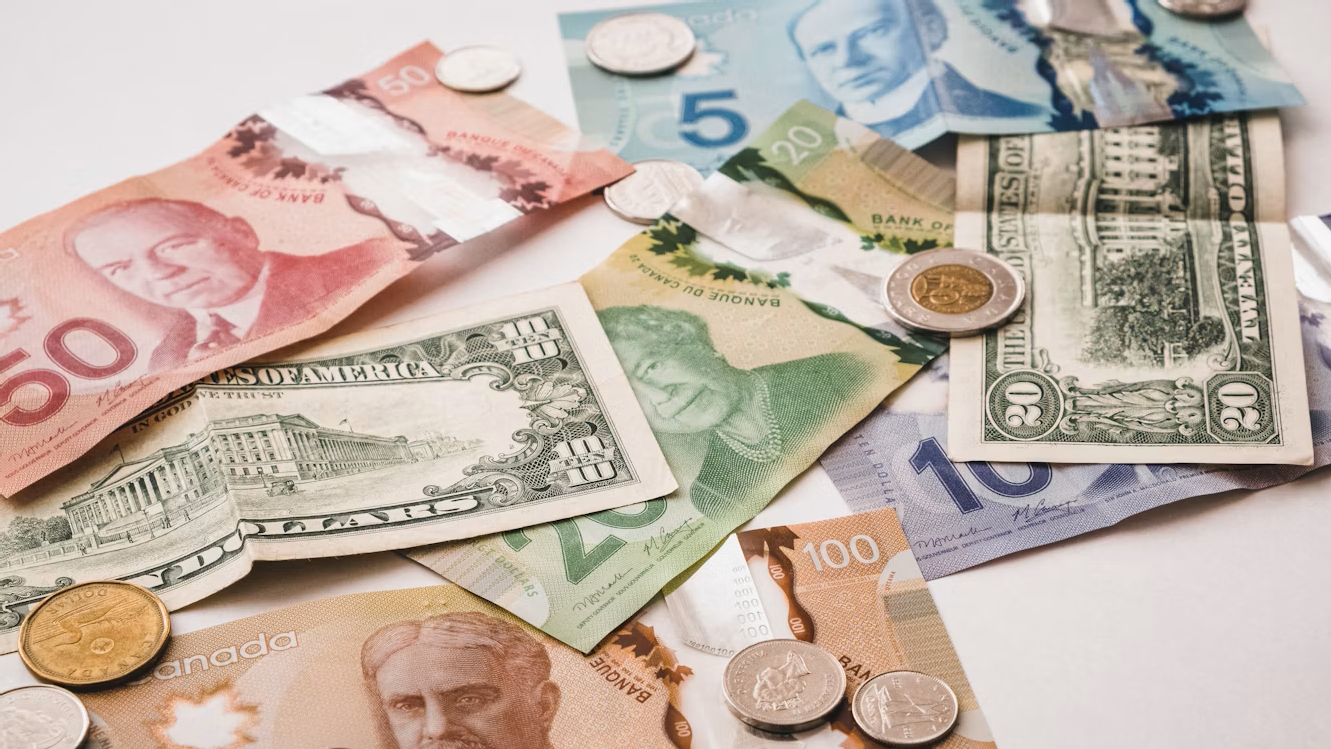
Maybe you’re exchanging travel cash for an upcoming trip, paying for an online purchase priced in United States dollars (USD), or sending a payment across the border. Before you commit, you want a straight answer to one question: How much is a currency exchange fee, really?
The honest answer is that it depends far more on where and how you exchange than most people realize. The same $1,000 can cost you $10 or $150 to convert, and the provider charging you $150 may be the one advertising “no fees.”
This guide breaks down typical currency exchange fees for Canadians, method by method, covering specialists, banks, cards, ATMs, and kiosks. You’ll also learn how to spot hidden costs and check any rate you’re offered.
One note before we start: exchange rates and fees change regularly, so the figures below reflect general cost structures rather than live quotes.
How much is a currency exchange fee?
Currency exchange fees typically total anywhere from under 1% to 8% or more of the amount exchanged, depending on the method you use. On a $1,000 exchange, that’s the difference between paying about $10 and paying $80 or more. Most of that cost hides in the exchange rate rather than in a posted fee.
Typical fee ranges by exchange method
Here’s how the most common options compare on total cost, including rate markups and service fees.
Don't Waste Money With Banks.
Get Exchange Rates Up to 2% Better With KnightsbridgeFX
| Exchange method | Typical total cost |
| Currency exchange specialists | Often under 1% |
| Banks and credit unions | 2% to 3.5%, plus possible service fees |
| Credit and debit cards abroad | 2.5% to 5.5% |
| ATM withdrawals abroad | 3% to 6%, plus flat fees |
| Airport and tourist kiosks | 8% to 15% |
Why the real fee is usually in the rate, not on the receipt
Every currency pair has a mid-market rate, which is the midpoint between global buy and sell prices, and it’s the rate you see on Google or a currency converter like XE. No retail provider gives you that rate. They build their profit into the rate they offer you, then advertise low or zero fees.
That spread between the mid-market rate and your rate is the real fee. Banks typically build a 2% to 3% markup into their exchange rates, while airport kiosks and tourist-area exchanges often mark up 8% to 10% or more. None of it appears as a line item on your receipt, which is exactly why so many Canadians only notice the cost when the statement arrives.
Currency exchange fees by method
Each method charges you differently, and it’s important to understand those variations clearly.
Currency exchange specialists
Currency exchange specialists make money on a small margin built into the rate, typically well under 1% on major currency pairs, with no service fees on top. Currency exchange is their entire business, so they run on volume and thinner margins than banks.
KnightsbridgeFX, for example, offers currency exchange for Canadians at rates typically 1.5% to 2.5% better than the banks, with no hidden fees and free transfers. The trade-off is a minimum exchange amount ($2,000 at KnightsbridgeFX), which makes specialists the best fit for larger exchanges rather than pocket money for a weekend trip.
Banks and credit unions
Banks charge through the rate markup, usually 2% to 3% over mid-market, and often add wire or service fees on top. They also post different cash and non-cash rates, so the rate for physical bills is usually worse than for an account-to-account conversion.
Banks are convenient if you already bank there, and reasonable for small amounts of travel cash ordered ahead of time. For the full picture of what each major Canadian bank charges, see our breakdown of bank exchange rates.
Credit and debit cards abroad
Card networks like Visa, Mastercard, and American Express convert your purchase at a rate close to mid-market. The higher cost comes from your card issuer: most Canadian credit cards add a foreign transaction fee of 2.5% on every purchase made in another currency.
These are two separate charges, and you can pay both at once:
- Foreign transaction fee: A surcharge from your card issuer applied to any purchase in a foreign currency
- Currency conversion cost: The markup built into the exchange rate used to convert the purchase, which is set by the network or—with dynamic currency conversion—by the merchant
A handful of Canadian cards come with no foreign exchange fees, which removes the surcharge but not the conversion itself. Cards remain one of the cheaper ways to spend abroad if you avoid the traps covered below.
ATM withdrawals abroad
Withdrawing cash abroad stacks several charges: your bank’s foreign ATM fee (up to 3.5% at some Canadian banks), a flat fee from the ATM operator, and the rate markup on the conversion. Total costs of 2.5% to 3.5%, on top of a flat fee of $1–$5, are common. Small withdrawals push the percentage higher because the flat fees stay the same.
ATMs make sense for modest amounts of local cash on arrival, but be sure to use bank-owned machines, decline any offer to convert to Canadian dollars (CAD) at the terminal, and withdraw once rather than several times.
Airport and tourist kiosks
Airport kiosks are the most expensive mainstream option. It’s not uncommon for airport exchanges to charge 14% more than the official exchange rate, with some premiums exceeding 17%. Kiosks serve a captive audience with no time to comparison shop, and the “0% commission” signs simply mean the entire cost sits in the rate.
The hidden costs that inflate your exchange fee
Three costs never show up as a line item, and they do most of the damage:
1. Exchange rate markups over the mid-market rate
The markup is the gap between the mid-market rate and the rate you’re offered, and it applies to nearly every method mentioned above. A 3% markup on a $10,000 exchange is $300 gone before any visible fee is charged. Providers count on customers comparing posted fees instead of rates, so a “fee-free” exchange can quietly cost more than one with a visible fee and a sharper rate.
2. Dynamic currency conversion
Dynamic currency conversion (DCC) is the offer to pay in Canadian dollars when a foreign terminal, ATM, or website gives you the choice. It feels reassuring, but it’s also one of the worst deals in travel. The DCC rate typically includes a markup of 3% to 7% over the real rate, and your card’s 2.5% foreign transaction fee can still apply on top. Always choose the local currency and let your card network handle the conversion.
3. Flat fees and small-amount penalties
Flat charges punish small exchanges disproportionately. A $5 ATM operator fee plus a $3.50 charge from your own bank is 4.3% on a $200 withdrawal before the rate markup even enters the math. Wire fees and kiosk service fees work the same way: the smaller the exchange, the larger the share extra fees take.
How to calculate what you’re really paying
Don’t take any provider’s marketing on trust. Run this check:
- Look up the mid-market rate on Google or a currency converter like XE.
- Note the rate your provider offers for the same currency pair.
- Convert your amount at both rates and take the difference.
- Add any flat fees, then divide the total cost by your amount to get a percentage.
Say the mid-market rate is 1 CAD = 0.7300 USD, and your bank offers 0.7080. Exchanging $1,000 CAD gets you $708 USD instead of $730, a $22 USD difference, or roughly 3%. Add a $16 wire fee and the true cost climbs to about 5%. The check works for any currency pair, from Canadian dollars into euros (EUR), British pounds (GBP), Mexican pesos (MXN), or Japanese yen (JPY).
This same test works on any provider, including KnightsbridgeFX. We publish transparent rates precisely so customers can run the math before they commit.
How to keep currency exchange fees low
You can’t avoid exchange costs entirely, but a few habits cut them dramatically:
Avoid the most expensive venues
Never exchange at airports or hotels unless it’s a genuine emergency, and even then, convert only enough for the day. When a terminal or merchant abroad offers to charge you in Canadian dollars, decline and pay in the local currency.
Consolidate and time your exchanges
One $3,000 exchange costs less than three $1,000 exchanges because flat fees are charged once and larger amounts often qualify for more competitive rates. If your timeline is flexible, watch the currency exchange rates for a few weeks before converting, as even a small rate movement matters at scale.
For more practical tactics, see our 10 ways to save on currency exchange.
Use a specialist for larger amounts
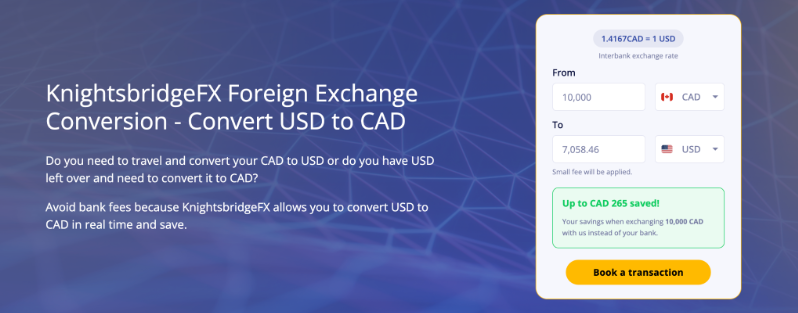
For exchanges of $2,000 or more, a specialist is usually the lowest-cost route. KnightsbridgeFX offers rates typically 1.5% to 2.5% better than the banks, checks bank rates daily, and backs it with a Best Rate Guarantee—if you find a better rate at your bank, we’ll beat it. There are no hidden fees, and transfers are free. On a $10,000 CAD to USD conversion, a 2% saving is $200 that stays in your pocket.
Keep the full value of your money
Currency exchange fees vary tenfold depending on where you exchange, and the visible fee is rarely the real cost. The rate markup is. Compare offered rates against the mid-market rate and the cheapest option becomes obvious: cards with no foreign exchange fees for small purchases abroad, and a specialist for anything larger.
KnightsbridgeFX is a Canadian company founded over 15 years ago, registered with FINTRAC, holding an A+ rating with the Better Business Bureau, and trusted by over 150,000 customers. Getting started is simple—just get a quote, confirm your rate, and transfer your funds securely.
Skip the markups and keep more of every exchange. Open a free KnightsbridgeFX account today and get bank-beating rates with no hidden fees.
Frequently asked questions about currency exchange fees
What is a typical currency exchange fee in Canada?
A typical currency exchange fee in Canada runs from 2% to 3% at banks and around 2.5% on credit card purchases, with specialists charging under 1% and kiosks charging far more. The fee is usually built into the exchange rate rather than listed separately, and many banks add service fees for wires or drafts on top of the rate markup.
How much does it cost to exchange $1,000?
Exchanging $1,000 costs anywhere from about $10 to $150, depending on the method. A currency exchange specialist typically costs under $10 in rate margin. A bank costs $20 to $35 once the markup and any service fees are counted. An airport kiosk can take $80 to $150 of the same $1,000 through its rate alone, which is why venue matters more than the amount.
What is the difference between a foreign transaction fee and a currency conversion fee?
A foreign transaction fee is a surcharge from your card issuer, typically 2.5% in Canada, applied whenever you pay in a foreign currency. A currency conversion fee is the markup built into the foreign exchange rate used to convert the purchase. They’re separate charges, and you can pay both at once. For example, accepting dynamic currency conversion at a terminal abroad adds a rate markup while your issuer’s foreign transaction fee still applies.
Why do airport currency exchanges charge so much?
Airport currency exchanges charge so much because they serve a captive market. Travellers who need cash immediately have no time to compare, so kiosks face little competitive pressure and pay high airport rents that get passed on through the rate. Markups of 8% to 15% over the mid-market rate are common. If you must use one, exchange only enough for your first day.

 AUD
AUD CAD
CAD EUR
EUR GBP
GBP NZD
NZD USD
USD
