
If you head south every winter or pay for property, healthcare, or seasonal living costs in the United States, you don’t buy U.S. dollars once. You buy them again and again. And every time you do, the rate you get decides how much of your money you keep.
Most Canadians assume their bank gives them a fair deal on U.S. dollars. It doesn’t. Every time you convert Canadian dollars (CAD) to United States dollars (USD), your bank quietly builds a margin into the exchange rate. You won’t see it as a fee on your statement. It’s hidden inside the rate itself, and on a recurring USD need it adds up fast.
The deciding factor isn’t convenience or speed. It’s the exchange rate, and specifically the spread your provider charges above the real market rate.
This guide breaks down where you can buy U.S. dollars in Canada, how each option prices the exchange, and how to get the best USD rate every time you convert.
First, two terms worth knowing. The mid-market rate is the real, live exchange rate, the midpoint between what buyers and sellers are trading at globally. It’s the rate you see on the Bank of Canada site or a financial news feed. The spread is the gap between that mid-market rate and the rate your provider actually offers you. The wider the spread, the more you lose on every dollar.
Don't Waste Money With Banks.
Get Exchange Rates Up to 2% Better With KnightsbridgeFX
Where to buy U.S. dollars in Canada
You have four realistic ways to buy USD in Canada, and each makes a different trade-off between rate, speed, and convenience. For a one-time traveller grabbing $300 in cash before a trip, the spread barely registers. For a snowbird converting tens of thousands of dollars a season, year after year, the spread is the single biggest cost, and it dwarfs everything else.
Here’s how the main options stack up.
At your bank
Buying USD through your Canadian bank is the most familiar route. You can order foreign cash at a branch, convert between linked CAD and USD accounts online, or send a wire to a U.S. account.
The convenience is real. The cost is too. Canadian banks typically embed a spread of 2% to 4% above the mid-market rate on currency exchange, depending on the bank, the currency, and how much you’re moving. If you want to see how the major banks compare directly, KnightsbridgeFX keeps a running breakdown of which Canadian bank has the best exchange rate.
Cash rates are usually the worst of all, because physical banknotes cost more to ship, store, and handle. Even non-cash conversions carry the spread. One published comparison pegged a major Canadian bank’s electronic USD markup at roughly 2.6% to 3.3%, with cash sitting higher still.
At a currency exchange specialist
A currency exchange specialist focuses on one thing: converting your money at a better rate than the banks. Because these providers operate lean, without branch networks or large marketing budgets, they price with much tighter spreads and pass the savings to you.
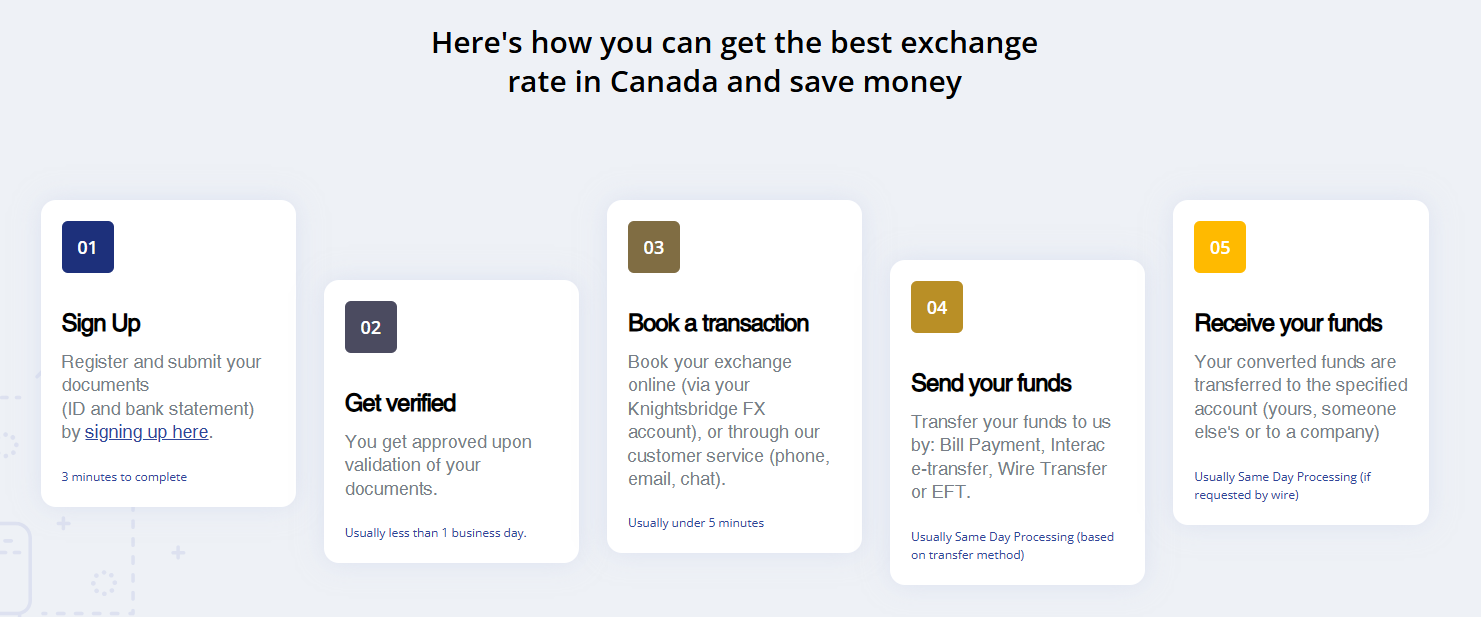
KnightsbridgeFX is a Canadian-owned currency exchange specialist built on a simple idea: exchanging currency shouldn’t be expensive. Instead of baking a large margin into the rate, it checks its rates against the banks every day and handles the full CAD to USD currency conversion between your Canadian accounts. No branch visit, no foreign cash to carry.
For recurring USD buyers, this is usually where the math turns decisively in your favour.
Through an online FX or transfer provider
A handful of fintech apps and money transfer services also let you buy or send USD online. Many show the mid-market rate up front and charge a separate, visible fee, which is a welcome change from the hidden-spread model.
The catch is that pricing and limits vary widely. Some apps are excellent for small everyday amounts but get expensive on larger sums. Others route through slower international payment rails that take three to five business days to settle. For a big, time-sensitive USD purchase like a property closing, that delay matters, so it’s worth understanding how to send money to the U.S. before you commit a large amount.
At the airport
Airport kiosks are the most convenient option and the most expensive by a wide margin. Markups frequently exceed 5% above the mid-market rate because you’re paying for location and last-minute desperation more than the currency itself.
Use them only for a small amount of walking-around cash you forgot to get earlier. Never use them for a meaningful USD purchase.
How to get the best USD exchange rate
The spread is quiet, but it isn’t small. On a small purchase, you might shrug it off. On a large or repeated USD need, it’s the difference between keeping your money and handing it to your bank.
Consider a simple example. Say the mid-market rate for CAD to USD is 1.3500 and your bank offers 1.3838. On a $10,000 exchange, that spread costs you a few hundred dollars; on a $100,000 property purchase, it climbs toward $3,000. Now multiply that by every season you head south. The losses compound quietly, which is exactly why so many snowbirds only realize the true cost after years of converting through their bank.
To get the best rate on every USD purchase:
- Benchmark against the mid-market rate. Pull the live CAD/USD rate from the Bank of Canada before you convert, so you can see exactly how much margin a provider is adding.
- Compare the rate, not the fee. A “no fee” headline means nothing if the spread is buried in the rate. The all-in rate you receive is the only number that matters.
- Favour electronic over cash. Cash rates are almost always worse. If you don’t physically need banknotes, convert electronically.
- Use a specialist for larger amounts. The bigger the transfer, the more a tight spread saves you. An online currency converter makes it easy to check the real cost before you lock anything in.
KnightsbridgeFX’s whole approach is built around this. Rates are checked against the major Canadian banks daily, there are no hidden fees layered on top, and the model is designed for larger and recurring transfers, which is where bank spreads hurt the most.
Buying USD cash vs. holding USD for cross-border spending
How you buy U.S. dollars should match how you’ll use them. Snowbirds and cross-border spenders generally choose between three approaches.
- Physical USD cash works for small, in-person spending: tips, parking, a meal out. It’s the most expensive way to convert, so keep these amounts modest.
- A USD bank account lets you hold US dollars and pay American bills, subscriptions, or a U.S. mortgage directly, without converting on every transaction. The key is converting your CAD into that account at a good rate in the first place.
- A direct USD transfer suits large, planned expenses like a property purchase, a seasonal lease, or a major payment to a U.S. recipient. This is where securing a tight spread saves you the most.
For most snowbirds, the smart play is to convert larger amounts at a strong rate through a specialist, hold the USD, and draw on it through the season rather than re-converting piecemeal at bank rates. KnightsbridgeFX works specifically with Canadian snowbirds for exactly this reason, since seasonal USD needs are where bank spreads quietly do the most damage.
Choosing the right way to buy your U.S. dollars
The right choice comes down to one principle: the larger and more frequent your USD needs, the more a tight spread outweighs the convenience of grabbing cash on the spot.
A one-time traveller buying $200 for a weekend trip can reasonably prioritize convenience. A snowbird converting $40,000 a season, or a cross-border owner paying U.S. property costs every month, cannot afford to ignore the spread. Over years of repeat conversions, the rate is the only variable that meaningfully changes how much money you keep.
If you fall into that second group, a Canadian currency exchange specialist almost always wins on the number that counts. KnightsbridgeFX has been in business since 2009, holds an A+ rating with the Better Business Bureau, and is registered with FINTRAC, Canada’s financial regulator, so you can verify its standing independently. It was also featured on CBC’s Dragons’ Den, where it drew investment offers from several Dragons. For a large USD transfer, that combination of better rates and verifiable trust is what you want behind your money.
Stop handing the banks a markup on every USD purchase
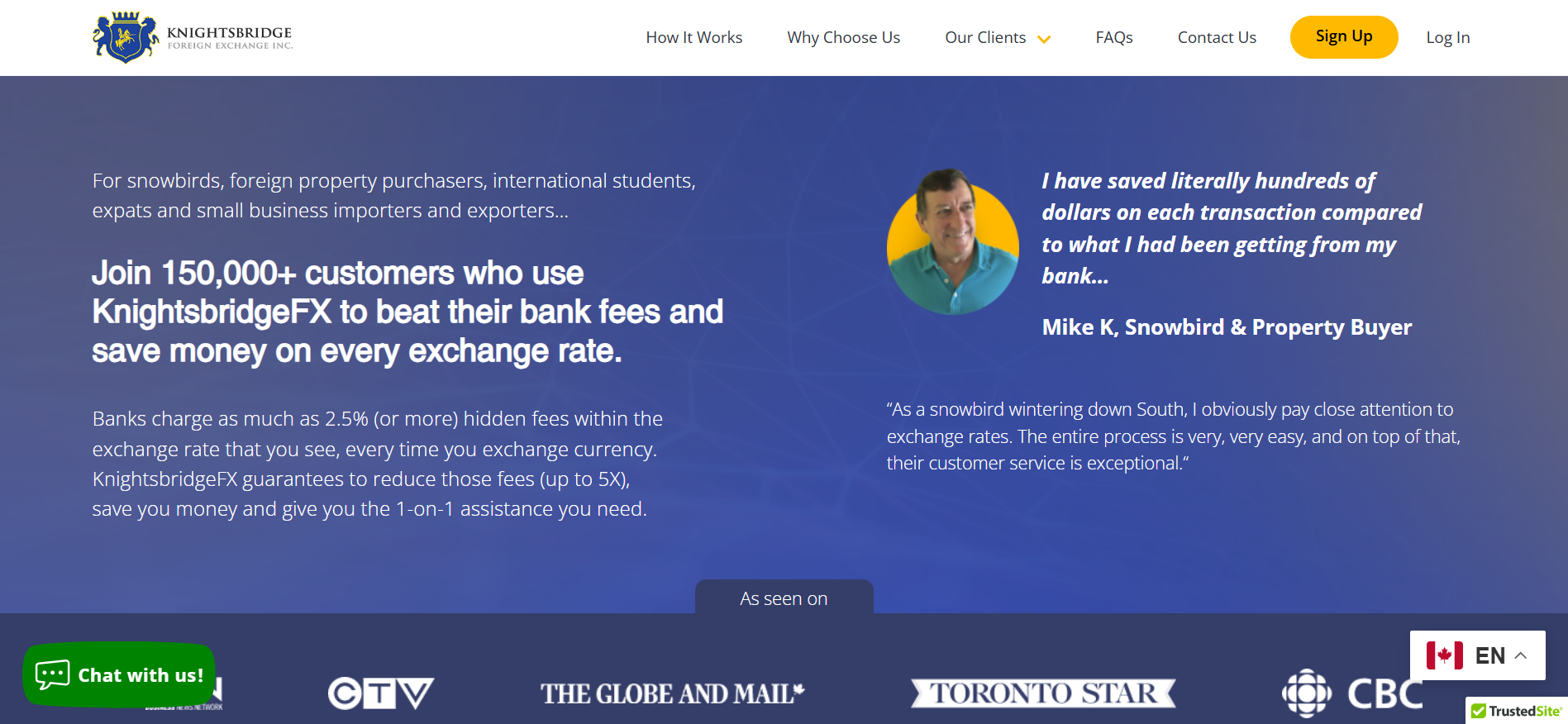
Every season you convert Canadian dollars through your bank, the spread quietly takes its cut, and over years of snowbird trips or cross-border payments, that adds up to real money. You don’t have to keep paying it.
Open a free KnightsbridgeFX account and secure rates better than the banks on every USD transfer. As a Canadian company that specializes in working with Canadians and Canadian banks, KnightsbridgeFX makes it easy to buy your US dollars online, at a rate that keeps more money in your pocket where it belongs.
Frequently asked questions about buying U.S. dollars in Canada
What is the cheapest way to buy U.S. dollars in Canada?
A Canadian currency exchange specialist is usually the cheapest way to buy USD, because these providers charge much tighter spreads than banks or kiosks. Banks typically add 2% to 4% above the mid-market rate, and airport kiosks often charge more than 5%. To find the true cheapest option, compare the all-in rate you receive against the mid-market rate, rather than trusting “no fee” claims.
Is it better to buy USD in Canada or in the U.S.?
For most Canadians, it’s better to buy USD in Canada through a specialist or your own USD account before you travel. Exchanging cash at a U.S. bank or kiosk as a non-customer usually means poor rates and possible service fees. The exception is small top-ups once you’re there. For anything substantial, lock in a good rate in Canada first.
Can I buy U.S. dollars online in Canada?
Yes. You can buy USD entirely online through a currency exchange specialist or transfer provider, moving funds between your Canadian CAD and USD accounts without visiting a branch. KnightsbridgeFX, for example, lets you convert and transfer USD online at rates checked against the bank’s daily rates, with real specialists available by phone, email, or chat if you need help.

 AUD
AUD CAD
CAD EUR
EUR GBP
GBP NZD
NZD USD
USD
